
www.medical-devices.tech
09
'26
Written on Modified on
Automated Kinematic Alignment Planning in Robotic Total Knee Arthroplasty
DePuy Synthes launches the VELYS Robotic-Assisted Solution with AutoPlan to automate kinematic alignment workflows in total knee arthroplasty.
www.jnjmedtech.com
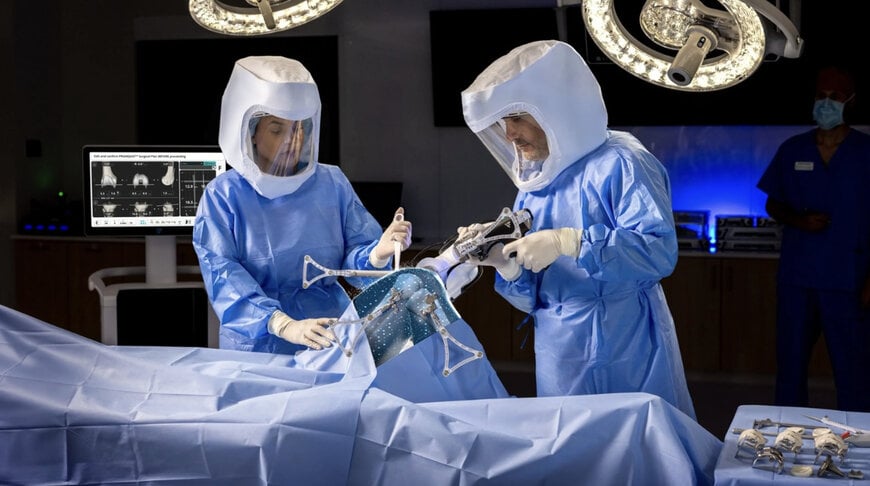
Rising procedural volumes in joint reconstruction paired with projected surgical workforce deficits demand digital systems that minimize cognitive fatigue while executing patient-specific biomechanical alignments. Addressing this operating-room workflow constraint, DePuy Synthes introduced the VELYS Robotic-Assisted Solution with AutoPlan to automate kinematic alignment planning during total knee arthroplasty.
Cognitive Load and Kinematic Alignment Challenges
Total knee arthroplasty (TKA) has progressively shifted from standard mechanical alignment, which creates perpendicular joint lines relative to mechanical axes, toward kinematic and functional alignment techniques. Kinematic alignment aims to co-localize prosthetic joint surfaces with individual constitutional anatomy, preserving natural soft-tissue laxity and restoring native joint kinematics. However, calculating patient-specific resection depths, component rotations, and joint line obliquity requires real-time synthesis of multi-planar radiographic and intraoperative dynamic ligament data.
This technical complexity creates substantial cognitive demands. Surgeons must balance multi-axis varus-valgus, flexion-extension, and rotational orientations while adjusting for dynamic soft-tissue envelopes. Long-term demographic forecasts project a 56 percent increase in the annual TKA-to-orthopedic-surgeon ratio in the United States between 2017 and 2050. As procedural throughput escalates, manual digital re-planning across complex multi-variable parameters increases surgical planning duration and mental demand, making automated algorithmic assistance essential to modern surgical workflows.
Algorithm Architecture and Neurological Workload Metrics
The AutoPlan system operates as an automated software extension within the VELYS Robotic-Assisted platform. The software synthesizes pre-defined surgical alignment parameters and joint stability envelopes set by the operating surgeon, algorithmically computing an initial kinematic alignment resection plan with a single user prompt. Rather than requiring step-by-step manual adjustments of virtual cutting planes across the distal femur and proximal tibia, the system produces a verified trajectory that the clinician inspects, fine-tunes, and approves prior to robotic bone resection.
The functional impact of this automated architecture was evaluated in a prospective simulated operative study involving 11 orthopedic surgeons, comparing AutoPlan against conventional manual robotic planning in TKA. Neurological monitoring through functional near-infrared spectroscopy (fNIRS) assessed real-time prefrontal cortex hemodynamic activity during plan generation.
The clinical findings demonstrated measurable reductions in cognitive and operative demands:
- Surgeons experienced an overall surgical planning workload reduction of 44 percent alongside a 55 percent reduction in mental demand, with both parameters achieving statistical significance at p < 0.001.
- Functional near-infrared spectroscopy confirmed an objective physiological reduction in cognitive strain. AutoPlan generated a 27 percent reduction in peak prefrontal cortex oxygenation and a 37 percent decrease in duration-dependent oxygenation (p < 0.02), indicating lower sustained mental concentration and peak intellectual strain during operative planning.
- Procedural user-interface efficiency improved through an average 25 percent reduction in software click count (p < 0.001), decreasing tactile input overhead and virtual planning duration.
Orthopedic surgeon Kevin I. Perry of Mayo Clinic highlighted that managing multiple anatomical variables during complex reconstructive planning benefits directly from automation, noting that automated planning mitigates operative cognitive strain while maintaining surgeon authority over definitive clinical determinations.
Ecosystem Integration and Clinical Deployment Schedule
AutoPlan integrates directly into the broader DePuy Synthes Kinematic Restoration framework, interfacing with the ATTUNE Knee System implant portfolio to reconcile implant geometry with patient-specific ligament tensioning. System verification and data presentations took place at the American Association of Hip and Knee Surgeons (AAHKS) 2026 Annual Meeting at booth 1105, which featured hands-on evaluations alongside the VELYS Hip Navigation platform.
Active clinical deployment is underway at targeted orthopedic surgery centers across the United States. DePuy Synthes plans phased commercial distribution expanding across broader hospital networks through the first quarter of 2027.
Additional Context:
This section details technical specifications and competitive benchmarking not included in the original product announcement.
In the orthopedic robotics landscape, surgical robotic platforms for TKA fall primarily into two structural categories: image-based systems and imageless intraoperative navigation systems. Competitor platforms such as the Stryker Mako System require preoperative computed tomography (CT) scans to construct three-dimensional bone models and register resection boundaries before the patient enters the operating suite. While CT-guided systems offer high structural fidelity, they introduce radiation exposure and supplementary imaging expenditures.
In contrast, the VELYS Robotic-Assisted Solution operates as an imageless optical platform. It registers anatomical landmarks and limb axes intraoperatively via optical tracking arrays, eliminating preoperative CT acquisitions. Competitive imageless platforms in this category include the Zimmer Biomet ROSA Knee System and the Smith and Nephew CORI Surgical System. While conventional imageless platforms require manual digital manipulation of resection angles through mouse or touchscreen interfaces, AutoPlan's algorithm introduces rule-based auto-generation for kinematic restoration, reducing intraoperative registration and boundary-definition time.
The integration of functional near-infrared spectroscopy to validate surgeon cognitive ergonomics reflects an emerging benchmark in computer-assisted orthopedic surgery design. Regulatory clearance for orthopedic robotic planning software falls under the United States Food and Drug Administration (FDA) 510(k) pathway for computer-assisted surgical instruments (product code OLO). As surgical guidelines increasingly incorporate personalized kinematic targets over rigid mechanical neutral axes, the integration of automated predictive modeling is becoming an industry standard for maintaining surgical workflow efficiency without compromising patient-specific anatomical alignment.
Edited by Natania Lyngdoh, Induportals editor, with AI assistance.
www.jnjmedtech.com

