
www.medical-devices.tech
03
'26
Written on Modified on
Fraunhofer ITWM develops AI tools for personalized pancreatic cancer care
RELEVIUM combines wearable monitoring and explainable AI to tailor exercise, nutrition and pain management, aiming to improve patients’ quality of life.
www.fraunhofer.de

Advanced pancreatic cancer presents severe clinical hurdles due to late diagnosis, aggressive metastasis, and disabling cancer cachexia that traditional, episodic hospital oncology visits cannot sufficiently manage. In response to these complex outpatient supportive care demands, the Fraunhofer Institute for Industrial Mathematics ITWM, as part of the European Union RELEVIUM consortium, has developed explainable artificial intelligence algorithms and wearable tracking tools to automate multimodal exercise, pain, and nutrition interventions.
Clinical Monitoring Challenges in Advanced Palliative Oncology
Pancreatic ductal adenocarcinoma accounts for two to three percent of all diagnosed malignancies but remains among the deadliest oncological conditions due to nonspecific early indicators and rapid systemic progression. Patients routinely experience severe physical decline characterized by intractable pain, involuntary skeletal muscle wasting, cachexia, and profound systemic fatigue. Traditional therapeutic frameworks rely predominantly on intermittent, hospital-based palliative treatments, leaving clinicians with little visibility into daily functional fluctuation once patients return home.
Effective palliative intervention demands continuous physiological tracking to adjust supportive therapies alongside standard systemic chemotherapy. The RELEVIUM project consortium addresses this care gap by integrating commercial wearable hardware, remote sensing, and algorithmic decision support to translate continuous outpatient physiological signals into actionable supportive care workflows.
Explainable Algorithmic Architecture for Exercise Prescription
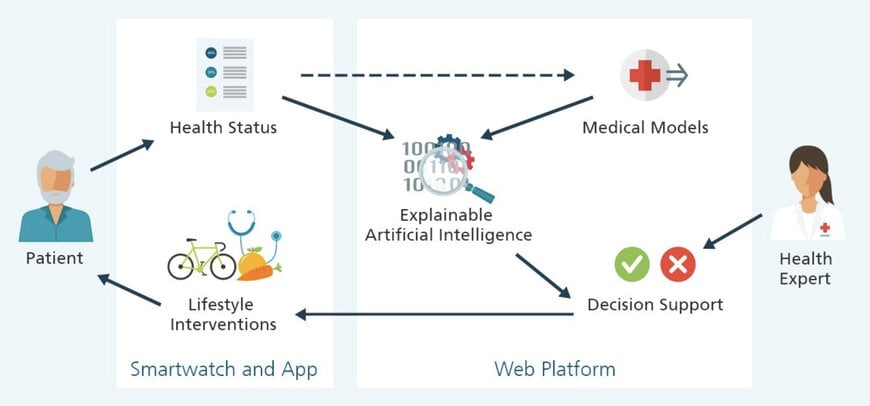
Physicians require reliable, longitudinal patient biometrics to design supportive therapy without increasing clinical documentation overhead. Under the RELEVIUM framework, outpatient cohorts receive sensor-equipped smartwatches and a mobile patient application that continuously capture activity profiles, subjective pain scores, and dietary intake logs.
To translate raw biometrics into clinical actions, Fraunhofer ITWM researchers developed knowledge-based algorithmic pipelines combined with explainable artificial intelligence (XAI) models. In typical deep-learning platforms, recommendation logic functions as an uninterpretable black box. By contrast, the XAI models deployed here expose the causal connections between specific physiological parameters and proposed changes in physical activity, allowing treating clinicians to inspect the algorithmic rationale before approving modifications.
Physical activity serves as an essential therapeutic countermeasure against sarcopenia and cancer-induced fatigue. Sports medicine specialists at Johannes Gutenberg University Mainz continuously supervise and validate the exercise regimens formulated by the system. The algorithms ingest patient completion metrics and exertion feedback from each completed workout, automatically recalibrating subsequent endurance and strength sessions to avoid overexertion while preserving functional muscle mass.
"Exercise can significantly improve physical well-being. With regular physical activity tailored to their needs, patients report having more strength for daily activities, feeling less fatigued and enjoying a much better quality of life," stated Alexander Scherrer, Senior Consultant for Optimization in Life Sciences at Fraunhofer ITWM. "The same AI-based approach to refining and adapting exercise plans can also be applied to nutrition and pain and stress management. For years, medicine focused primarily on treatment. Now, patient care and satisfaction are increasingly taking center stage."
Multimodal Data Synthesis and Clinical Dashboard Integration
Collected patient telemetry feeds predictive disease models designed to identify functional decline before acute decompensation requires hospitalization. The underlying mathematical models analyze multivariate correlations between symptom progression, nutritional deficits, and physical capability.
"The data provides valuable input for developing medical models and designing effective interventions. Explainable artificial intelligence methods help us understand the factors that affect health," explained Jonas Flechsig, research scientist at Fraunhofer ITWM.
Processed insights populate a centralized clinical dashboard shared between attending medical teams and outpatient users. The platform visualizes computed patient-condition indices, tracks trajectory regressions, and alerts oncologists to early drops in overall well-being, while preserving the physician as the definitive clinical decision authority.
"The data is analyzed, transformed into meaningful indicators of patient condition and then displayed on the dashboard. This analysis helps develop causal models to predict disease progression and provide an early warning of any decline in patient quality of life. The analysis results must be understandable and must be used ethically for intervention planning," added Scherrer. "It is also important to emphasize that the digital tools and assistance systems are intended solely to aid in decision-making. Healthcare professionals remain responsible for determining what action to take."
Clinical Trial Protocol and Multicenter Validation
The technical platform is undergoing formal validation in an international, multicenter randomized clinical trial enrolling approximately 50 participants diagnosed with advanced pancreatic malignancies. Within the study protocol, automated treatment adjustments for physical training, caloric intake, and analgesic regimens are recalculated at one- to two-week intervals based on real-time wearable streams. Alongside functional quality-of-life indices, investigators are measuring overall intervention cost-effectiveness, regional healthcare equity, and informal caregiver burden across participating European healthcare systems.
Additional Context:
This section details technical specifications and competitive benchmarking not included in the original product announcement.
The RELEVIUM research initiative is funded through the European Union Horizon Europe Research and Innovation framework under Grant Agreement 101057821, spanning a 48-month operational window from September 2022 through August 2026. The consortium brings together 18 partner institutions across ten European nations, coordinated clinically by Universitaetsmedizin der Johannes Gutenberg-Universitaet Mainz. In addition to commercial wearable smartwatches, the system architecture interfaces with emerging biosensing hardware, including investigational non-invasive remote ultrasound patches designed to evaluate progressive muscle wasting and structural sarcopenia.
Clinical software solutions deploying artificial intelligence within European oncology must comply with the European Union Artificial Intelligence Act (Regulation EU 2024/1689) classification requirements for high-risk medical software, as well as the Medical Device Regulation (EU 2017/745) for Clinical Decision Support Systems (CDSS). The integration of explainable AI directly addresses these regulatory constraints by establishing transparent algorithmic audit trails, preventing autonomous medical deviations from European Society for Medical Oncology (ESMO) clinical practice guidelines for cancer cachexia and palliative care.
Digital health interventions in palliative oncology have historically relied on electronic Patient-Reported Outcome (ePRO) platforms, such as Epic Systems MyChart-integrated surveys, Kaiku Health, or Careive. Conventional platforms operate largely through asynchronous self-reporting questionnaires that alert care teams when symptom severity crosses static thresholds. The RELEVIUM framework advances beyond static survey alerting by integrating continuous physiological biometric ingestion, causal predictive progression modeling, and dynamic closed-loop prescription adjustments for multimodal supportive therapy.
Edited by Natania Lyngdoh, Induportals editor, with AI assistance.
www.fraunhofer.com

