
www.medical-devices.tech
02
'26
Written on Modified on
GE HealthCare debuts Allia Celeo
Allia Celeo pairs an extra-wide-bore ceiling C-arm with an AI-powered image chain and predictive analytics to streamline interventional cardiology and radiology workflows.
www.gehealthcare.com
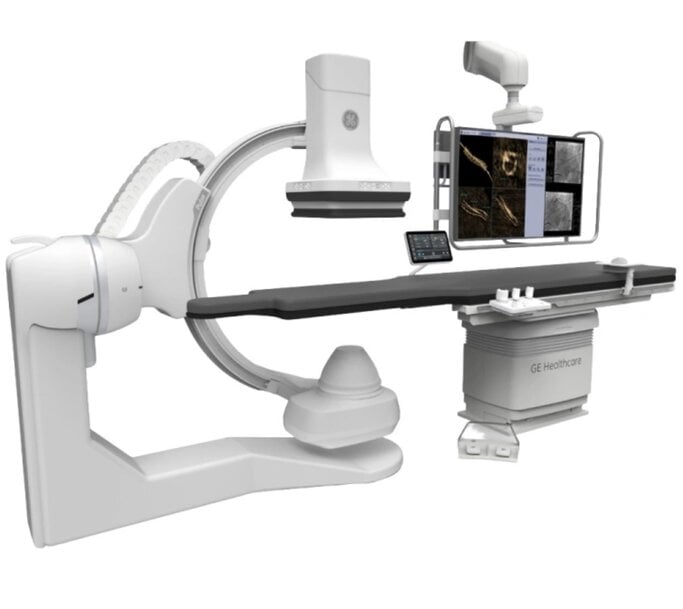
Interventional suites in high-volume healthcare networks face intensifying operational strain as procedure volumes grow across structural heart interventions, complex coronary procedures, and multi-disciplinary interventional radiology and oncology cases. Historically, maneuvering bulky imaging gantries within hybrid cath labs has introduced physical and spatial bottlenecks. Rigid floor- or ceiling-mounted C-arms with external cabling bundles often obstruct staff sightlines, clash with surrounding anesthesia booms or surgical tables, and restrict rotation angles during steep cranial and caudal views, especially when treating patients with high body mass indexes. Furthermore, frequent manual adjustments of X-ray tube parameters, table heights, and imaging projections interrupt procedural momentum, while unexpected hardware downtime halts operating schedules. Addressing these operational challenges requires ceiling-suspended imaging architectures designed with integrated cable routing, wide bore clearances, digital twin positioning tools, and AI-driven background radiation and image optimization.
Ceiling Architecture, Digital Twin Navigation, and Procedural Flow
To eliminate physical constraints and maintain case momentum, GE HealthCare introduced Allia Celeo at the Transcatheter Cardiovascular Therapeutics (TCT) 2026 conference in San Diego. Designed for high-throughput interventional departments, the system features a slim, symmetrical ceiling gantry engineered with fully integrated internal cabling to maximize usable floor clearance for multidisciplinary clinical teams and mobile auxiliary equipment.
The mechanical geometry incorporates an extra-wide-bore C-arm profile and a thin detector lift, limiting visual barriers across the operating table to facilitate direct communication between operators and support staff. The increased bore clearance allows continuous rotation around patients to achieve steep diagnostic angulations without physical interference, accommodating bariatric patients. High-speed ceiling panning combined with extended longitudinal table movement provides head-to-toe anatomic coverage. Through the integrated InnovaBreeze functionality, the system coordinates automated table stepping and gantry translation to visualize peripheral lower-limb vasculature in a single contrast acquisition.
To streamline positioning, clinicians can command gantry trajectories and table offsets from multiple in-room touchpoints or simulate projections beforehand using an interactive on-screen digital twin. Jyoti Gera, Chief Executive Officer of CardioVascular and Interventional Solutions (CVIS) at GE HealthCare, highlighted that the ceiling-mounted addition expands the Allia family by offering hospitals physical configuration flexibility tailored to their specific room layouts, rather than requiring clinical teams to conform to rigid equipment limitations.
AI-Assisted Image Chain and Multidisciplinary Clinical Software
At the core of Allia Celeo is a dedicated AI-enabled image processing chain engineered to autonomously modulate X-ray exposure parameters, tube filtration, and detector gain settings in real time. This closed-loop automated balancing delivers high contrast and edge sharpness across diverse body habitus while minimizing the total ionizing radiation dose administered to patients and interventionists. In addition, the rendering pipeline provides one-click access to customized cardiac and vascular presentation modes matching individual clinician preferences.
The platform integrates directly with GE HealthCare's cleared cardiovascular and interventional imaging solutions:
- Coronary and Structural Heart: Supports StentViz and 3DStent for enhanced radiographic visualization and expansion assessment of endovascular stents, Valve ASSIST 2 for structural transcatheter heart valve planning, and the Mac-Lab hemodynamic recording system with native fractional flow reserve (FFR) and resting diastolic pressure ratio (dPR) calculation tools.
- Interventional Radiology and Oncology: Interfaces with Embo ASSIST AI for automated vessel identification and transarterial embolization targeting, Vessel ASSIST for real-time 3D vascular roadmapping, and Needle ASSIST for multi-plane virtual needle path tracking.
- Bedside Ultrasound and System Telemetry: Facilitates wireless streaming from Vscan Air handheld point-of-care ultrasound devices and interfaces with third-party intravascular ultrasound (IVUS) and optical coherence tomography (OCT) consoles.
To prevent unplanned suite closures, Allia Celeo incorporates compatibility with OnWatch Predict, a deep learning diagnostic service architecture that continuously monitors thermal trends, mechanical component cycles, and high-voltage generator performance 24 hours a day to identify potential hardware degradation prior to component failure. Kat Davis, General Manager of Interventional Solutions, emphasized that from predictive gantry simulations to automated dose governance, the system is designed to eliminate incremental workflow friction so clinical teams can maintain procedural focus.
Additional Context
This section details technical specifications and competitive benchmarking not included in the original product announcement.
Interventional fluoroscopy suites are governed by international radiation safety standards and performance mandates such as IEC 60601-2-43 (governing the basic safety and essential performance of X-ray equipment for interventional procedures) and the ALARA (As Low As Reasonably Achievable) principle. Modern flat-panel dynamic digital detectors in cardiac and vascular catheterization suites typically employ amorphous silicon or complementary metal-oxide-semiconductor (CMOS) sensor plates with cesium iodide (CsI) scintillator coatings, providing high detective quantum efficiency (DQE) exceeding seventy percent at low air-kerma dose levels. By applying deep neural network filtering to raw fluoroscopy frames, AI-based image chains can perform real-time spatiotemporal noise suppression and scatter compensation without the high-frequency lag or motion blur historically experienced during rapid cardiac catheter wire manipulations.
Within the interventional angiography market, GE HealthCare’s Allia Celeo competes directly against established ceiling-mounted fixed C-arm platforms such as the Siemens Healthineers Artis Q and ARTIS icono ceiling, the Philips Azurion 7 C20, and Canon Medical Systems' Alphenix Sky. While competing solutions such as the ARTIS icono incorporate multi-axis articulation to reach complex obliques, they often rely on extensive articulating knuckle assemblies that require substantial ceiling track infrastructure and load-bearing ceiling reinforcement. In contrast, Allia Celeo utilizes a streamlined, low-profile symmetrical ceiling gantry with internally routed power and signal lines to limit mechanical ceiling loads and preserve overhead room space for surgical lights and radiation shields. By coupling the ceiling platform with automated virtual collision avoidance, predictive hardware monitoring, and cross-modality software integration with intraoperative ultrasound and hemodynamic consoles, GE HealthCare targets multi-specialty hybrid operating rooms seeking to balance high cath-lab patient throughput with advanced vascular surgical flexibility.
Edited by Romila DSilva, Induportals Editor, with AI assistance.

