
www.medical-devices.tech
21
'26
Written on Modified on
General Imaging Ultrasound Workflow Automation
GE HealthCare introduced LOGIQ Focus to accelerate diagnostic throughput and enhance tissue characterization across general imaging, primary care, and specialized diagnostics.
www.gehealthcare.com
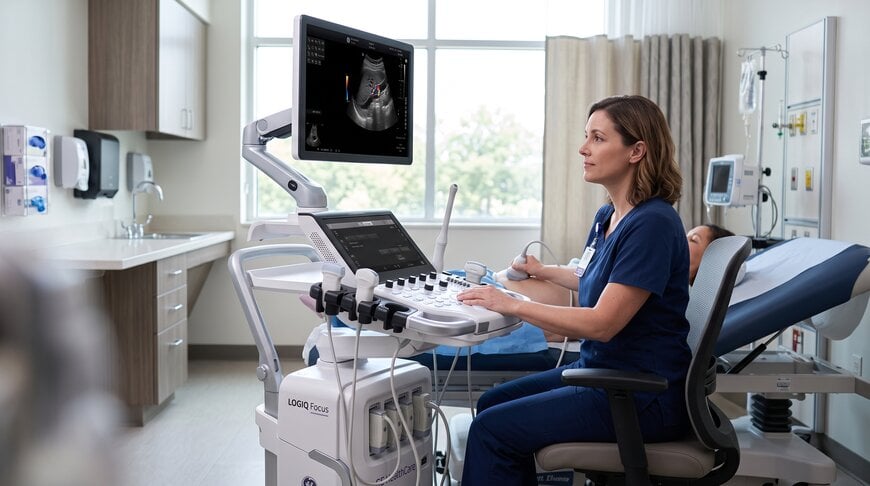
Rising patient examination volumes and staffing shortages place increasing operational strain on diagnostic imaging departments, requiring ultrasound platforms that minimize manual user interventions without compromising image fidelity. The introduction of LOGIQ Focus by GE HealthCare addresses these clinical workflow bottlenecks by pairing dedicated beamforming architecture with artificial intelligence tools designed for routine screening and complex diagnostic evaluations.
Beamforming Architecture and Acoustic Processing
At the core of the system is the cSound architecture, a software-based acoustic processing platform that collects and reconstructs ultrasound channel data to maintain spatial and contrast resolution throughout the entire field of view. By utilizing advanced speckle reduction algorithms alongside a High Definition Ultrasound display, the platform suppresses acoustic artifacts while preserving boundary definition and fine tissue differentiation.
The architecture supports multi-purpose and specialty transducers, as well as the wireless, cable-free Vscan Air CL probe to facilitate cable-free bedside examinations. For hemodynamic evaluation, integrated flow visualization tools process Doppler signals to resolve low-velocity microvascular blood flow alongside high-velocity arterial profiles without blooming artifacts. In comparative clinical evaluations against predicate systems, LOGIQ Focus demonstrated a 26 percent increase in examination operational speed, with 90 percent of clinician evaluators rating overall image quality as excellent.
Automated Protocol Guidance and Quantitative Assessment
Operational efficiency within clinical environments relies on standardizing scan acquisition protocols and reducing operator-dependent variability. LOGIQ Focus integrates the Auto Preset Assistant, an anatomical recognition algorithm that detects the targeted structure and applies optimal beamforming and post-processing presets. This feature eliminates up to five manual configuration clicks per exam and reduces time spent on automated tasks by up to 25 percent.
Diagnostic reproducibility is further supported through specialized quantification algorithms. For cardiovascular screening, the AutoEF tool identifies endocardial borders to automate ejection fraction calculations for left ventricular assessment. Protocol adherence is maintained via Scan Assistant, which sequences acquisition steps and standardizes annotation formatting.
For hepatic tissue characterization, the system incorporates Ultrasound-Guided Fat Fraction analysis to quantify liver fat burden, as well as two-dimensional shear wave elastography to measure acoustic shear wave propagation velocities, providing an objective measurement of liver tissue stiffness indicative of fibrosis. Inter-departmental coordination is supported by Verisound Collab, an integrated digital network tool for real-time virtual collaboration and remote consultation.
Data Protection and Hardware Maintenance
To meet hospital network IT requirements, the platform utilizes SonoDefense, a defense-in-depth cybersecurity framework incorporating multiple independent layers of security controls, encrypted communication protocols, and operating system safeguards to prevent unauthorized data access and maintain device integrity.
"We designed LOGIQ Focus around what clinicians told us they need most: confidence on the first pass, a workflow that keeps pace, and a system they can count on to be there when they need it," stated Michael Greene, General Manager, General Imaging, Primary Care and Automated Breast Ultrasound, USS, GE HealthCare. "LOGIQ Focus includes features so care teams spend less time on the system and more time with the patient, on a connected platform designed to evolve with their needs."
Additional Context
This section details technical specifications and competitive benchmarking not included in the original product announcement.
General imaging ultrasound systems occupy a central role in clinical tiering between high-throughput point-of-care ultrasound devices and ultra-premium cart-based consoles. Across this market segment, competitive benchmarks such as the Philips Affiniti series and the Siemens Healthineers ACUSON Redwood rely on automated anatomical recognition, elastography packages, and digital remote interfaces to improve department efficiency.
A primary technical driver across general imaging ultrasound platforms is the implementation of quantitative shear wave elastography and acoustic fat fraction estimation. While conventional B-mode ultrasound offers qualitative echogenicity comparison between liver parenchyma and renal cortex, quantitative biomarkers provide standardized kilopascal stiffness values that correlate directly with METAVIR fibrosis stages. Similarly, software beamforming architectures such as cSound reflect a broader shift across medical diagnostic equipment away from hardware-bound digital signal processors toward software-defined synthetic aperture processing, expanding channel data capture and field-of-view processing power through periodic algorithmic updates.
Edited by Evgeny Churilov, Induportals Media - Adapted by AI.
www.gehealthcare.com

