
www.medical-devices.tech
19
'26
Written on Modified on
Automated Low-Flow Anesthesia Control Systems Reduce Gas Consumption
GE HealthCare End-tidal Control software on Aisys CS2 workstations automates fresh gas flow and volatile anesthetic regulation in hospital operating rooms.
www.gehealthcare.com
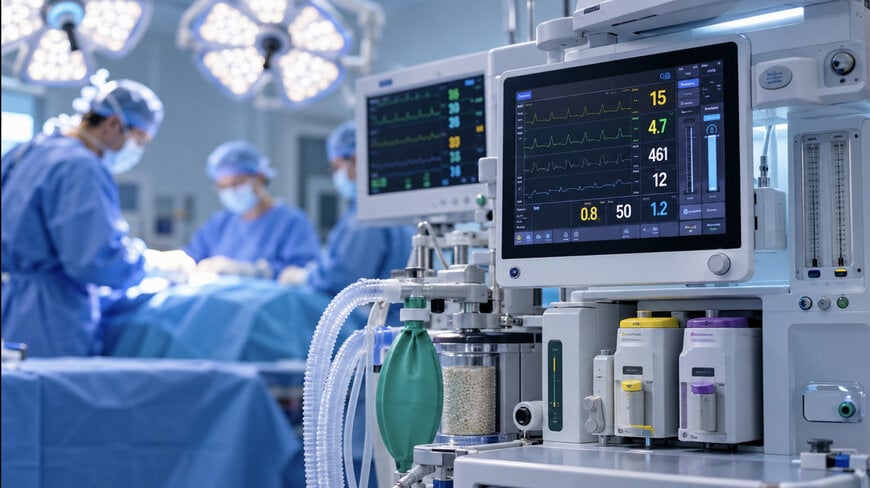
Delivering low-flow inhalational anesthesia manually requires continuous clinician vigilance and frequent adjustments to fresh gas flow and vaporizer settings to prevent hypoxic gas mixtures or unintended changes in anesthetic depth. In perioperative hospital environments and large academic health systems, automating the regulation of end-tidal oxygen and volatile anesthetic concentrations addresses this operational challenge, helping clinical teams reduce waste gas emissions and pharmacological expenditures. To evaluate how automated gas delivery performs in routine clinical workflows, a research collaboration between the University of Michigan and GE HealthCare analyzed the real-world adoption and operational impact of End-tidal Control software across a multisite academic health system.
Engineering Challenges in Manual Low-Flow Anesthesia Delivery
During the maintenance phase of general anesthesia, patients metabolize only a small fraction of the delivered volatile anesthetic agent. When fresh gas flow rates exceed patient uptake and circuit losses, the excess gas is vented through the hospital scavenging system into the atmosphere. While lowering fresh gas flow rates conserves expensive volatile agents such as sevoflurane and minimizes environmental carbon dioxide equivalents, manual low-flow techniques increase clinical workload. As fresh gas flow is reduced, a larger proportion of exhaled gas is recirculated through the circle breathing system, causing the inspired gas composition to diverge significantly from the fresh gas settings set by the clinician.
Consequently, manual low-flow delivery demands constant monitoring of patient hemodynamic and metabolic shifts, accompanied by frequent manual adjustments to oxygen flowmeters and anesthetic vaporizers. Without automated closed-loop feedback, clinicians often default to higher fresh gas flow rates to maintain a wider safety margin and reduce cognitive burden during complex surgical procedures.
Operating Principles of Automated End-Tidal Control Software
Integrated into the GE HealthCare Aisys CS2 anesthesia delivery system, End-tidal Control software replaces repetitive manual gas adjustments with an automated closed-loop control algorithm. Instead of manually titrating fresh gas flow and vaporizer percentages, the anesthesia clinician inputs target end-tidal oxygen concentrations, target end-tidal anesthetic agent concentrations, and a minimum total flow rate.
The system continuously monitors patient respiratory gases via an integrated airway gas module and automatically modulates fresh gas concentrations and flow rates of oxygen, balance gas, and volatile anesthetic to achieve and maintain the clinician-set targets. Prior randomized controlled noninferiority trial data published in Anesthesia & Analgesia in October 2024 demonstrated that automated end-tidal control maintains target gas concentrations with greater accuracy than manual adjustments while remaining clinically noninferior in safety. In the United States, the software is indicated for patients aged 18 years and older, and clinical decisions regarding agent selection and flow rates remain under the judgment of the attending clinician in accordance with specific pharmaceutical labeling warnings for low-flow sevoflurane use.
Real-World Clinical Performance and Workflow Integration
To quantify how automated gas control translates from controlled trials into high-volume hospital workflows, researchers at the University of Michigan conducted a retrospective observational study published in Anesthesia & Analgesia Practice on October 16, 2026. The analysis evaluated 12,818 adult general anesthesia cases performed across University of Michigan Health locations in Ann Arbor between April 1, 2023, and September 30, 2024, utilizing anesthesia workstations equipped with End-tidal Control software. Partial funding for data extraction and analysis was provided by GE HealthCare, with the study protocol and statistical analysis plan approved a priori by the University of Michigan Department of Anesthesiology Anesthesia Clinical Research Committee.
Across the evaluated surgical procedures, clinical teams elected to utilize End-tidal Control in 6,755 cases, representing a 52.7% adoption rate in routine clinical practice. During the maintenance phase of anesthesia, use of the automated software was associated with a 62.3% reduction in median fresh gas flow compared to cases managed manually. This reduction in carrier gas flow corresponded with a 39.3% reduction in sevoflurane consumption, alongside lower estimated carbon dioxide equivalents released during anesthetic maintenance.
"Our team wanted to understand not only if End-tidal Control would be chosen for use in routine practice, but also how its use was associated with anesthesia delivery and environmental measures across a large academic health system," said Douglas A. Colquhoun, MB ChB, MSc, MPH, Associate Professor of Anesthesiology at the University of Michigan. "These findings suggest that End-tidal Control had a high adoption rate and, when used in real-world practice by anesthesia clinical teams it could translate to significant reductions in fresh gas flow resulting in projected cost saving and benefits for the environment."
John Beard, MD, anesthesiologist and Chief Medical Officer of Patient Care Solutions at GE HealthCare, noted that the University of Michigan research adds real-world evidence of End-tidal Control use at scale and how it may help reduce fresh gas flows and anesthetic agent consumption as health systems seek practical ways to support clinicians while advancing sustainable care.
Crucially, the statistical analysis revealed that variation in software utilization was heavily influenced by the individual in-room anesthesia clinician. This finding indicates that hardware and software deployment alone does not guarantee uniform operational efficiency; hospitals must pair automated anesthesia workstations with targeted clinical education, workflow integration, and institutional protocols to maximize low-flow adoption across all anesthesia providers.
Additional Context:
This section details technical specifications and competitive benchmarking not included in the original product announcement.
In the broader medical device sector, automated closed-loop gas delivery has become a primary engineering focus as healthcare systems work to reduce scope 1 emissions from volatile fluorinated anesthetics, which act as potent greenhouse gases. Sevoflurane, isoflurane, and desflurane possess 100-year global warming potentials ranging from approximately 130 to over 2,500 times that of carbon dioxide, prompting regulatory and clinical bodies including the American Society of Anesthesiologists and European healthcare authorities to advocate for low-flow and minimal-flow anesthesia techniques.
From a technical standpoint, the GE HealthCare Aisys CS2 workstation executes End-tidal Control using its Aladin2 electronic cassette vaporizer and CARESCAPE respiratory gas monitoring architecture, which samples respiratory gases at 120 mL/min (±20 mL/min) using infrared and paramagnetic sensing while compensating for atmospheric pressure and gas cross-effects. According to U.S. Food and Drug Administration Premarket Approval documentation (P210018) and manufacturer technical manuals, the End-tidal Control algorithm operates with desflurane, sevoflurane, and isoflurane cassettes when the patient's measured carbon dioxide respiratory rate is 35 breaths per minute or less. The system can reach 90% of the target end-tidal anesthetic agent concentration within an average of 90 seconds, supports minimum flow settings down to 0.5 L/min, and has demonstrated a greater than 50% reduction in manual keypad presses compared to manual titration. If measured end-tidal oxygen falls below 80% when set to maximum, or if circuit anomalies occur, the system automatically increases gas flows to prevent hypoxic gas delivery.
Several competing anesthesia workstation manufacturers offer comparable automated target-controlled gas delivery systems, though availability varies by regional regulatory clearance. Primary industry benchmarks include the Getinge Flow-i and Flow-c workstations equipped with Automatic Gas Control (AGC), the Dräger Zeus Infinity Empowered (IE) workstation featuring Target Controlled Anesthesia (TCA), and the Mindray A9 anesthesia system with Automatic Controlled Anesthesia (ACA). While GE HealthCare's End-tidal Control received FDA Premarket Approval for commercial use in the United States in March 2022, Getinge subsequently secured FDA approval for its Automatic Gas Control software on Flow Family machines in 2024. Getinge's AGC allows clinicians to select predefined speed steps to reach target end-tidal agent concentrations and regulates oxygen enrichment alongside total flow, whereas Dräger's Zeus IE utilizes quantitative closed-system dosing via direct injection vaporizers (DIVA) rather than conventional variable-bypass cassettes. Across all platforms, clinical benchmarks evaluate system response time to target MAC (minimum alveolar concentration), overshoot suppression during wash-in, and stability during surgical stimulation.
Edited by Sucithra Mani, Induportals editor – adapted by AI.
www.gehealthcare.com

