
www.medical-devices.tech
15
'26
Written on Modified on
Stryker launches Sonopet 3 ultrasonic platform for precise tissue removal
FDA-cleared Sonopet 3 combines enhanced power, precision and ergonomics with RISE workflow integration and Pulse Control for controlled tissue resection.
www.stryker.com
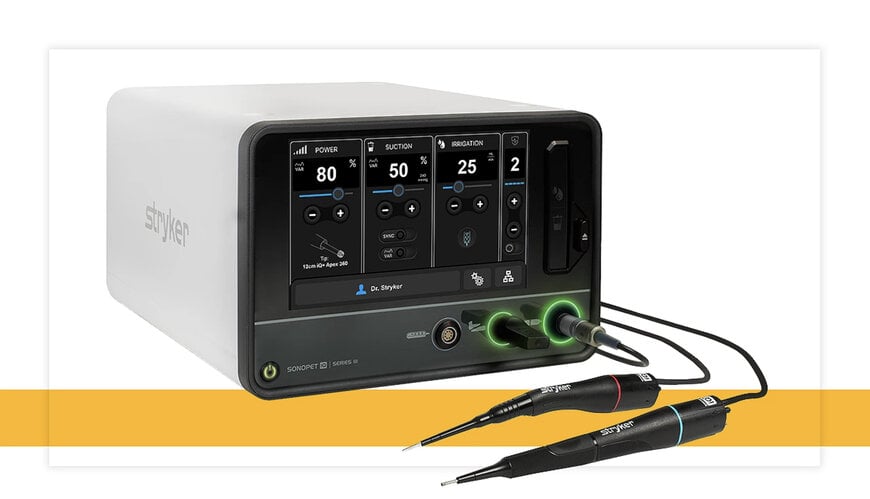
Surgical procedures in neurosurgery and adjacent disciplines require selective dissection of hard osseous structures and delicate soft tissue near critical neurovascular bundles, where mechanical rotatory burs risk thermal necrosis and soft tissue wrap. Stryker has addressed these clinical constraints through the development of Sonopet 3, an ultrasonic bone and soft tissue removal console intended for advanced surgical suites.
Acoustic Cavitation and Ultrasonic Bone Sculpting Principles
Ultrasonic aspirators utilize the converse piezoelectric effect to convert high-frequency electrical signals into longitudinal mechanical vibrations at the handpiece tip. When applied to soft tissue, low-frequency longitudinal oscillation creates rapid localized pressure differentials, causing intracellular acoustic cavitation that fragments non-collagenous, fluid-rich tissue while sparing elastin- and collagen-rich structures such as dura mater and arterial walls. When specialized abrasive or osteotomy tips are attached, the longitudinal stroke translates into ultrasonic bone emulsification without the rotational kickback associated with pneumatic or electric high-speed drills.
Sonopet 3 incorporates Pulse Control technology, a modulation feature that alters the duty cycle of the ultrasonic waveform. By delivering acoustic energy in discrete bursts rather than continuous waves, the system allows surgeons to regulate tissue ablation rates across varying anatomical densities, improving selective resection of dense calcified lesions, osteophytes, and adjacent soft tissues without excessive thermal buildup.
Console Connectivity and Surgical Suite Workflow Integration
Modern operating room integration demands standardized device management and reduced instrument footprint across complex procedures. Sonopet 3 introduces the RISE (Reimagined Integrated Surgical Experience) system architecture, designed to connect the ultrasonic console into hospital network infrastructures and integrated digital operating theaters.
The console system was developed using design input from neurosurgeons, resulting in modified handpiece ergonomics to reduce surgeon hand fatigue during prolonged cranial and spinal procedures. The unified system platform allows switching between hard-tissue ultrasonic bone shaving and soft-tissue tumour aspiration within a single connected setup, reducing intraoperative changeover time and simplifying sterile processing workflows. Clinical evaluation cases are scheduled for October, preceding broader commercial distribution.
Additional Context:
This section details technical specifications and competitive benchmarking not included in the original product announcement.
Ultrasonic surgical aspirators represent standard capital equipment in neurosurgical, neuro-otologic, and spinal surgical centers. Benchmarking within the category centers on drive frequency, tip excursion amplitude, aspiration regulation, and multi-tissue capability. The legacy Sonopet platform typically operated around 25 kHz for selective bone cutting and up to 34 kHz for soft-tissue aspiration.
The primary competitive benchmark in this equipment category is the Integra LifeSciences CUSA (Cavitation Ultrasonic Surgical Aspirator) platform, including the CUSA Clarity and CUSA Excel systems. The CUSA Clarity platform operates using dual frequencies (23 kHz and 36 kHz) targeting tough fibro-dense fibrous masses and soft parenchymal tumors, equipped with Adaptive Power technology to maintain vibrational amplitude under load. While CUSA has historically dominated soft-tissue intracranial decompression with defined aspiration and irrigation balance, Stryker's Sonopet ecosystem established an early technological position by combining both osteotomy (bone shaving) and soft-tissue cavitation within a single handpiece console.
Other relevant industry benchmark platforms include the Söring ultrasonic surgical portfolio, which utilizes low-frequency ultrasound (25 kHz and 35 kHz) coupled with high-frequency electrosurgery modules, and the Olympus Thunderbeat, which integrates bipolar radiofrequency and ultrasonic energy primarily for laparoscopic general surgery rather than craniomaxillofacial or spinal applications.
Regulatory drivers in the United States governing these devices fall under FDA product code LFL (Instrument, Ultrasonic Surgical) regulated under 21 CFR 878.4400. Compliance benchmarks require stringent controls on thermal energy transfer to adjacent tissues, limiting acoustic unintended thermal injury, and ensuring sterile barrier integrity through single-use suction and irrigation tubing sets.
Edited by Natania Lyngdoh, Induportals editor, with AI assistance.
www.stryker.com

