
www.medical-devices.tech
16
'26
Written on Modified on
Cyclotron Systems for Local Radiopharmaceutical and Theranostic Production
GE HealthCare has secured CE Mark certification for its MINItrace Magni cyclotron and expanded the PETtrace Solid Target Platform to Copper-64.
www.gehealthcare.com
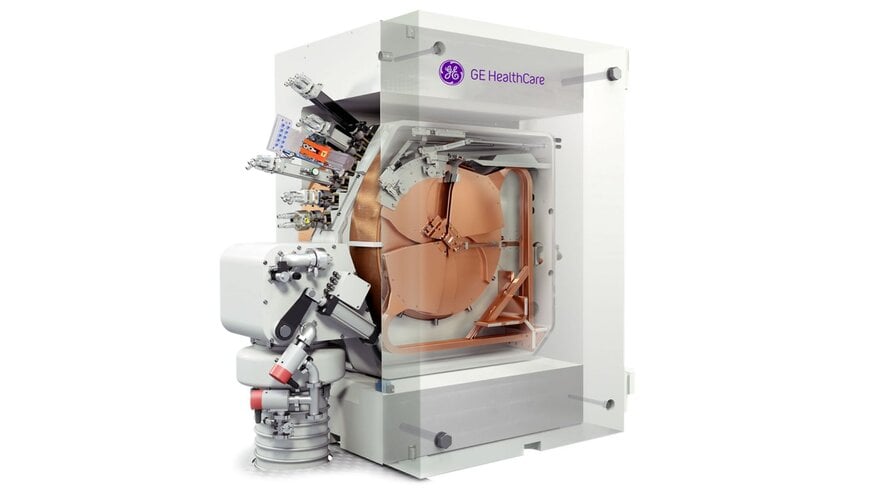
Decaying radioisotope half-lives and volatile supply logistics present operational bottlenecks for clinical positron emission tomography programs. To eliminate third-party transport dependencies and support emerging theranostic research, GE HealthCare has secured European CE Mark regulatory clearance for its compact MINItrace Magni cyclotron and introduced Copper-64 production capabilities to its PETtrace Solid Target Platform.
Operational Challenges in Radiotracer Logistics and Solid-Target Radioisotopes
Clinical positron emission tomography relies on radionuclides characterized by physical half-lives ranging from approximately two minutes for Oxygen-15 up to 109.8 minutes for Fluorine-18. Because radioisotopes experience rapid radioactive decay, medical facilities that procure radiotracers from regional centralized radiopharmacies face narrow geographical distribution windows, schedule vulnerabilities, and dose degradation during transit.
Simultaneously, the clinical expansion of molecular imaging into theranostics—where diagnostic scans guide matched therapeutic radionuclide treatments—has intensified demand for non-standard metallic radioisotopes. Conventional hospital cyclotrons predominantly utilize gas or liquid targets, limiting local yields of radiometals. Transitioning to solid-target bombardment offers substantially higher production yields but introduces complex material handling, heat dissipation, and radiation-protection requirements that conventional nuclear medicine centers struggle to implement without heavy infrastructure modifications.
Architecture and Automation of the MINItrace Magni Cyclotron
The MINItrace Magni system addresses facility space and radiation containment constraints through an integrated, self-shielded design that avoids the excavation and construction overhead of thick-walled concrete bunkers. The cyclotron is engineered for automated multi-isotope synthesis, providing local target irradiation for Fluorine-18 (18F), Carbon-11 (11C), Oxygen-15 (15O), and Nitrogen-13 (13N).
Operation is governed by automated process sequences designed to reduce technician dose exposure and operator-dependent setup errors. A three-click user interface executes routine runs via an auto-tuning system that automates cyclotron initialization, radiofrequency matching, ion-source management, beam tuning, and target bombardment management. For downstream synthesis, the system connects into TRACERcenter Solutions, integrating synthesis cassettes, fluidic paths, and radiopharmacy workflows required to convert irradiated target material into final injectable compounds.
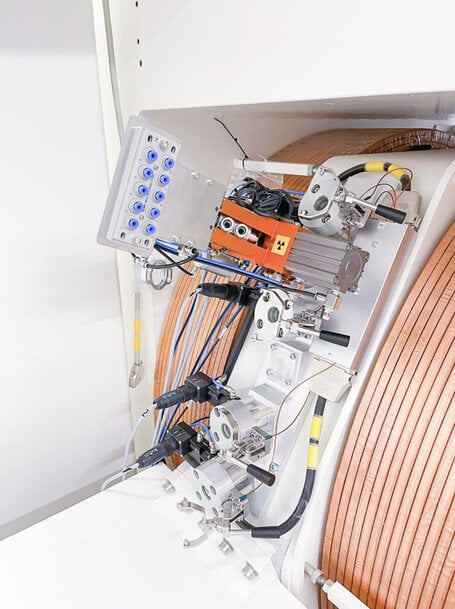
PETtrace Solid Target Expansion to Copper-64
Complementing local short-lived tracer generation, the PETtrace Solid Target Platform expands solid-phase targetry to support Copper-64 (64Cu) production. Initially launched for Gallium-68 (68Ga) in 2022 and expanded to Zirconium-89 (89Zr) in early 2026, the modular solid-target system uses direct particle bombardment on solid metallic matrices to yield multi-Curie batches of radiometals within existing PETtrace installations.
Copper-64 possesses a physical half-life of 12.7 hours, enabling biological tracking over extended pharmacokinetic timelines. Its intermediate half-life makes it suitable for labeling larger biomolecules, such as monoclonal antibodies and peptide conjugates, in oncology research targeting prostate carcinoma and HER2-positive breast cancer. From an engineering and radiotherapeutic standpoint, 64Cu functions as a diagnostic positron-emitting analogue to Copper-67 (67Cu), a beta-emitting radioisotope. This creates an identical chemical theranostic pair, ensuring that diagnostic imaging with 64Cu precisely predicts biodistribution, clearance kinetics, and internal absorbed dose metrics prior to 67Cu targeted therapeutic irradiation.
Strategic Implications for Hospital Radiopharmacies
Integrating compact, self-shielded cyclotrons alongside solid-target radiometal modules shifts hospital radiochemistry from transactional third-party sourcing toward on-site production lines. As the clinical demand for personalized radiopharmaceuticals accelerates, automating accelerator beam tuning and solid-target processing lowers the technical barrier for clinical centers to generate both high-turnover diagnostic biomarkers and specialized theranostic isotopes internally.
Additional Context:
This section details technical specifications and competitive benchmarking not included in the original product announcement.
In clinical cyclotron technology, self-shielded compact accelerators typically operate with proton beam energies between 7.8 MeV and 10 MeV to minimize secondary neutron activation, contrasting with larger unshielded hospital cyclotrons, such as the IBA Cyclone KIUBE or GE PETtrace 800 series, which deliver variable proton energies between 16.5 MeV and 19 MeV. The compact category, which also includes benchmark systems like the IBA Cyclone 18 and PMB Alcen iMiTrace, focuses on high-yield production of the primary PET tracer Fluorodeoxyglucose (18F-FDG) within footprint boundaries often under 20 square meters.
For solid-target radiometal production, achieving 64Cu typically requires proton bombardment of enriched Nickel-64 via the 64Ni(p,n)64Cu nuclear reaction. This process demands precise target thermal management and automated pneumatic transfer systems, as benchmarked by the Comecer ALCEO solid-target processing system and the ARTMS QUANTM Irradiation System (QIS). By embedding multi-metal target transfer mechanisms into the standardized PETtrace architecture, solid-target platforms allow existing 16.5–18 MeV cyclotron infrastructures to bypass reliance on Germanium-68/Gallium-68 generator supply limitations and support larger-scale multi-Curie clinical trial demands.
Edited by Natania Lyngdoh, Induportals editor, with AI assistance.
www.gehealthcare.com

