
www.medical-devices.tech
17
'26
Written on Modified on
Total Ankle Arthroplasty and Hexapod Limb Deformity Planning Systems
Stryker introduced integrated patient-specific preoperative modelling and mobile-guided external ring fixation algorithms for extremity reconstruction.
www.stryker.com
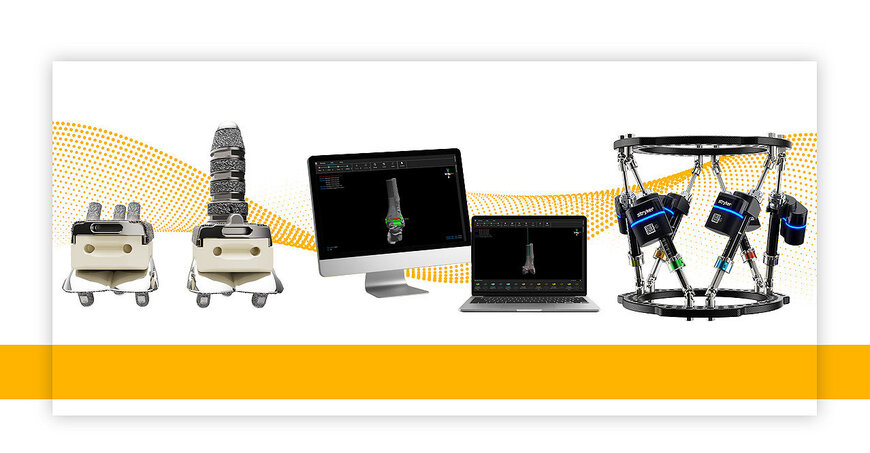
Stryker presented software-driven additions to its lower-extremity surgical portfolio during the American Orthopaedic Foot and Ankle Society Annual Meeting in Seattle. The commercial rollouts encompass preoperative patient-matched instrumentation protocols for end-stage ankle arthroplasty alongside a software-directed hexapod external fixation platform for complex limb salvage and realignment.
Patient-Specific Preoperative Planning and Total Ankle Implantation
Total ankle arthroplasty requires precise alignment relative to the mechanical axis of the tibia and talus to mitigate edge loading, eccentric polyethylene wear, and premature aseptic loosening. The integration of Prophecy Surgical Planning into the Incompass Total Ankle System uses computed tomography datasets to reconstruct patient-specific three-dimensional osseous geometry prior to intervention.
Using anatomical datasets derived from Stryker Orthopaedic Modeling and Analytics, the preoperative protocol models implant footprint coverage, joint-line elevation, and rotational orientation. Intraoperatively, the system translates digital plans to surgical execution through patient-specific cutting guides featuring dual fixation modalities: resect-through slotted guides that control sagittal and coronal blade trajectory, and pin-through options that register pinning references while accommodating standard instrumentation. These guides mitigate procedural outlier alignment deviations across the ankle axis.
Digital Trajectory Modeling and Hexapod Ring Fixation
Limb lengthening, non-union stabilization, and multi-planar deformity correction depend on the gradual adjustment of external ring fixators according to the mechanical principles of the Ilizarov method and hexapod geometry. The Hoffmann LRF smartHEX platform pairs an expanded circular and wire fixation ring matrix with a multi-axis strut adjustment engine.
The platform uses mathematical coordinate systems to calculate individual strut-length variations over prescribed distraction timelines. Through an integrated mobile software application, the platform digitizes the surgeon-specified correction schedule and delivers strut-adjustment parameters directly to the patient. This daily calibration interface monitors compliance, reduces translational and angular calculation discrepancies, and maintains stable multi-planar osseous distraction vectors throughout the post-operative osteogenesis phase.
Additional Context
This section details technical specifications and competitive benchmarking not included in the original product announcement.
In total ankle arthroplasty, patient-specific cutting blocks registered from preoperative computed tomography scans represent an established standard for coronal and sagittal alignment restoration. The primary market alternative is the Wright Medical (acquired by Stryker) Infinity and Vantage platforms, alongside Zimmer Biomet's Trabecular Metal Total Ankle, which utilizes conventional intramedullary alignment guides rather than patient-matched models. Direct competition in patient-specific guidance includes Enovis with the STAR total ankle system paired with 3D planning guides, and Corin Group's Apex 3D planning protocols. Prophecy distinguishes itself by anchoring cutting block orientation directly to a longitudinal reference base of over 100,000 processed clinical datasets.
In the computerized hexapod external fixator market, the primary benchmark is the Smith+Nephew Taylor Spatial Frame, which operates on a Stewart platform configuration driven by web-based trajectory calculation software. Orthofix offers a comparable alternative with the TrueLok Hexapod System, which relies on software-guided strut adjustment schedules. The Hoffmann LRF smartHEX system matches the six-axis degrees of freedom (angulation, translation, rotation, and length adjustment) present in these legacy platforms, but distinguishes its workflow by transitioning calibration schedules from passive web-based printouts to bidirectional mobile patient applications that guide real-time strut adjustments.
Edited by Evgeny Churilov, Induportals Media - Adapted by AI.
www.stryker.com

