
www.medical-devices.tech
16
'26
Written on Modified on
Predictive Healthcare Capacity Management Using Artificial Intelligence
GE HealthCare introduced a cloud application to forecast hospital capacity constraints, deploying machine learning models across health system networks.
www.gehealthcare.com
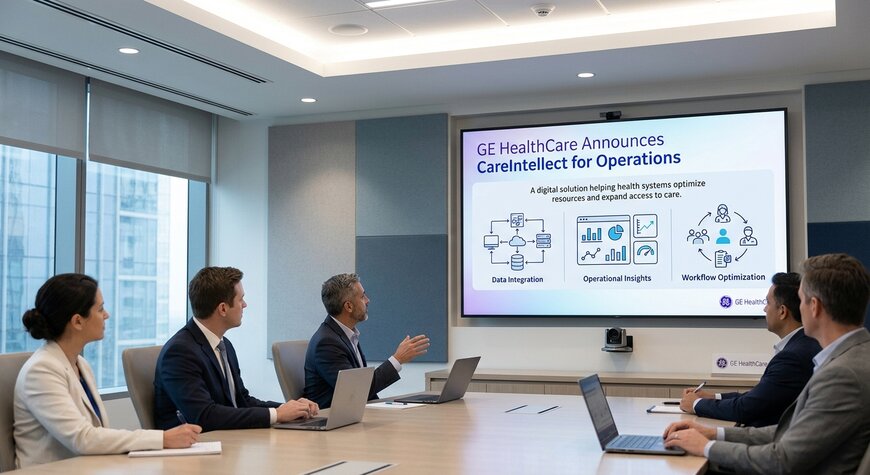
The Queen’s Health Systems and Duke Health have entered clinical evaluation agreements to deploy CareIntellect for Operations, a predictive Software-as-a-Service application built to forecast operational bottlenecks across inpatient healthcare networks. Designed for acute-care enterprise hospital environments, the software continuously assesses clinical and logistical variables to generate advance resource recommendations.
Predictive Data Processing for Operational Bottlenecks
Inpatient medical facilities face systemic operational pressures, highlighted by a 5.3 percent increase in inpatient volumes documented in 2025. Acute care facilities routinely experience operational friction caused by manual data aggregation, which requires clinical leaders to spend multiple hours per day reconciling disconnected electronic medical record (EMR) metrics and staffing rosters.
To automate this workflow, the SaaS platform integrates real-time EMR variables, bed inventories, emergency department wait times, ancillary procedural recovery logs, and inbound transfer requests. The platform processes these variables across two core machine learning models:
- The Pressure Forecast model correlates historical operations metrics with live resource utilization data to predict department-level, unit-level, and facility-wide resource constraints up to 72 hours in advance.
- The Estimated Day of Discharge model processes longitudinal patient clinical data, recalculating discharge probability hourly to maintain active capacity forecasts.
By mapping these predictive models directly into clinical administrative workflows, the system generates prioritized prescriptive actions. This allows operational coordinators to proactively reallocate nursing staff, reschedule elective intakes, and balance department censuses before service disruptions cascade across the enterprise.
Clinical Evaluation and Infrastructure Architecture
Duke Health and The Queen’s Health Systems serve as the initial implementation sites, providing clinical feedback loops to refine the models. The application is built on architectural principles derived from GE HealthCare Command Center software, which is deployed in approximately 500 facilities worldwide and has demonstrated outcomes including 20 million dollars in initial-year savings, a length-of-stay reduction exceeding 24 hours, and capacity increases accommodating 19,000 additional patients annually.
Built on Amazon Web Services (AWS) cloud infrastructure, the platform uses a centralized integration layer shared across the CareIntellect application suite. This unified cloud deployment eliminates independent API integrations for each application module and allows direct procurement via enterprise channels and the AWS Marketplace.
Additional Context
This section details technical specifications and competitive benchmarking not included in the original product announcement.
Operational capacity forecasting in enterprise acute care relies heavily on predictive accuracy, continuous EMR integration, and automated workflow triggers. In this technical domain, CareIntellect for Operations competes alongside platform solutions such as Epic Systems (Operational and Capacity Management tools within the Cogito suite) and specialized operational platforms like Qventus.
Clinical Evaluation and Infrastructure Architecture
Duke Health and The Queen’s Health Systems serve as the initial implementation sites, providing clinical feedback loops to refine the models. The application is built on architectural principles derived from GE HealthCare Command Center software, which is deployed in approximately 500 facilities worldwide and has demonstrated outcomes including 20 million dollars in initial-year savings, a length-of-stay reduction exceeding 24 hours, and capacity increases accommodating 19,000 additional patients annually.
Built on Amazon Web Services (AWS) cloud infrastructure, the platform uses a centralized integration layer shared across the CareIntellect application suite. This unified cloud deployment eliminates independent API integrations for each application module and allows direct procurement via enterprise channels and the AWS Marketplace.
Additional Context
This section details technical specifications and competitive benchmarking not included in the original product announcement.
Operational capacity forecasting in enterprise acute care relies heavily on predictive accuracy, continuous EMR integration, and automated workflow triggers. In this technical domain, CareIntellect for Operations competes alongside platform solutions such as Epic Systems (Operational and Capacity Management tools within the Cogito suite) and specialized operational platforms like Qventus.
- Integration Latency and Data Pipelines: Epic Systems uses native transactional EMR triggers operating at millisecond latencies, eliminating cross-platform ETL pipelines but remaining largely confined to Epic deployments. GE HealthCare and Qventus use cross-platform HL7 and FHIR-based data ingestion pipelines capable of connecting across heterogeneous EMR landscapes (such as mixed Oracle Health and Epic environments), though requiring secure cloud egress to AWS.
- Forecasting Horizons: While Epic's native predictive capacity models traditionally focus on census-level statistical projections and near-term 24-hour discharge probabilities, CareIntellect provides an extended 72-hour operational lookahead window using specialized multi-department constraint modeling. Qventus similarly offers advance predictive discharge and perioperative scheduling optimization, relying on machine learning models that generate automated behavioral nudges directly to frontline care teams.
- Prescriptive Decision Logic: Epic systems focus primarily on descriptive dashboards alongside native workflow scoring. Conversely, platforms like GE HealthCare and Qventus prioritize prescriptive scheduling logic, automatically converting raw census forecast deviations into prioritized action items for operational logistics managers.

