
www.medical-devices.tech
03
'26
Written on Modified on
High-Torque Small Bone Power Tool for Orthopaedic Procedures
Stryker developed a premium power tool system to enhance visibility, handpiece ergonomics, and thermal management during complex bone and metal cutting operations.
www.stryker.com
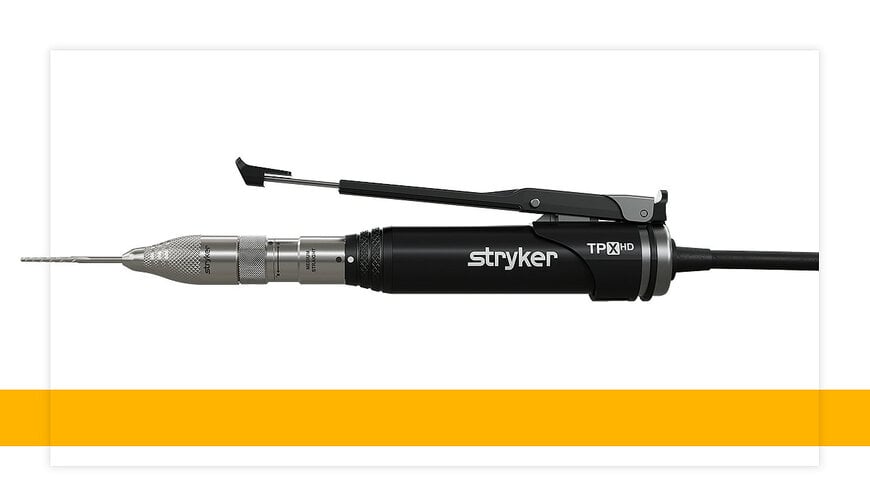
Medical institutions utilize small bone power tools for demanding orthopaedic procedures, including total joint revisions, minimally invasive surgery, and oral maxillofacial operations. These applications require high torque to cut through dense bone, metal components, and bone cement, often within restricted surgical fields.
The structural design of the handpiece addresses physical limitations commonly encountered during extended surgical interventions. By incorporating a tapered attachment architecture, the system increases the line of sight for clinicians operating in confined anatomical spaces. Thermal regulation is managed through a specialized housing structure designed to act as a barrier against motor heat during sustained high-speed operations. Furthermore, ergonomics are altered via a shorter handpiece length and a modified grip surface to minimize physical strain.
Mechanical Performance and Console Integration Control
Engineered specifically to handle high-resistance materials, the system demonstrates an increase of up to 296% more torque and a 40% improvement in speed performance compared to previous generations, such as the TPX Micro Drill, when operating at high speed. This mechanical output enables the efficient removal of robust fixations during total joint revisions without causing excessive motor stall.
Operational parameters are governed through software integration. The power tool connects to a centralized console, utilizing specific software that permits surgeons to customize the responsiveness and sensitivity curves of the drill. This integration allows for precise adjustments based on the varying density of cortical bone, cancellous bone, or metallic implants.
The system incorporates specialized modular attachments to accommodate different surgical disciplines. These include multiple attachment lengths, a 5:1 speed reducer for high-torque manual control, and dedicated modules optimized for metal and bone cement cutting.
Additional Context: Technical Specifications and Competitive Benchmarking
Small bone power tools operate within a stringent framework requiring a balance between thermal safety, power-to-weight ratio, and rotational precision. Standard configurations in the orthopaedic industry typically utilize brushless direct current motors to achieve high rotational speeds, which frequently generate significant friction heat. Standard compliance, such as IEC 60601-1 for medical electrical equipment, dictates strict surface temperature limits to prevent tissue necrosis during accidental patient contact.
When evaluated against comparable systems in the surgical market, like the Medtronic Midas Rex or DePuy Synthes Anspach systems, performance differentiators center on torque retention at high velocities. While standard micro-drills operate at speeds up to 75,000 RPM, they often experience a substantial drop in torque when encountering dense biomaterials or surgical metals like titanium and cobalt-chrome. The implementation of specific control software, alongside dedicated gear reduction attachments like a 5:1 reducer, allows the system to maintain stable torque delivery at lower output speeds, mitigating the risk of thermal damage to surrounding osseous tissue.
Edited by Evgeny Churilov, Induportals Media - Adapted by AI.
www.stryker.com

