
www.medical-devices.tech
12
'26
Written on Modified on
Deep Learning Integration and Gradient Performance in Magnetic Resonance Systems
GE HealthCare utilizes AI-driven reconstruction and sustainable hardware architectures to optimize throughput and data consistency within the global automotive data ecosystem and medical research sectors.
www.gehealthcare.com
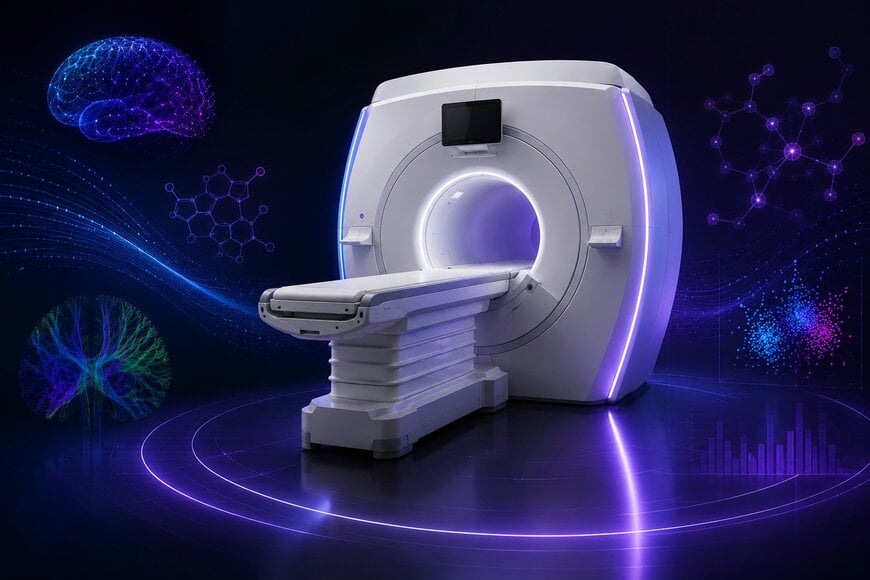
Medical imaging requirements are shifting toward high-performance hardware paired with deep learning–based software to reduce examination times while maintaining signal-to-noise ratios (SNR). These advancements are critical for multi-site longitudinal studies where data reproducibility is a primary technical requirement for translating research into clinical outcomes.
Deep Learning Acceleration in 2D and 3D Imaging
Recent developments in magnetic resonance (MR) technology focus on expanding deep learning reconstruction to a broader range of protocols. GE HealthCare has moved to expand its Sonic DL technology, previously limited to cardiac cine and 3D imaging, to include 2D imaging sequences. This expansion, currently pending U.S. FDA 510(k) clearance, targets up to 85% of standard MR examinations.
When integrated with AIR Recon DL, these algorithms reconstruct raw data to remove noise and truncation artifacts. This mechanism allows for higher acceleration factors without the traditional trade-off in image quality. Furthermore, the integration of deep learning with Zero Echo Time (ZTE) sequences enables "oZTEo" bone imaging. This provides CT-like visualization of cortical bone and lung tissue without the use of ionizing radiation, utilizing 3D volume rendering to enhance structural clarity.
Standardizing Workflows via Centralized Ecosystems
Variable operator experience and complex parameter sets often lead to inconsistencies in a digital supply chain of medical data. To mitigate this, the SIGNA One workflow ecosystem has been introduced to provide an AI-guided interface. This system features a "one-click" toggle between clinical and research modes, allowing institutions to run experimental protocols alongside standardized diagnostic scans without reconfiguring the system architecture.
Technical use cases for this streamlined workflow include:
- Reduced Training Latency: AI-guided positioning and parameter selection minimize the learning curve for new technologists.
- Increased Throughput: Automation of routine tasks reduces the total table time per patient.
- Data Reproducibility: Standardized sequences ensure that images captured at different sites remain comparable for large-scale analysis.
Hardware Evolution and Sustainability Standards
Hardware innovations presented at ISMRM 2026 (International Society for Magnetic Resonance in Medicine) in May 2026 emphasize gradient performance and cryogenic efficiency. The SIGNA Bolt, a 3T system, utilizes deep learning to optimize energy consumption during high-demand sequences.
Simultaneously, the transition toward "Freelium" technology addresses the global helium supply chain risk. The SIGNA Sprint with Freelium operates with less than 1% of the liquid helium required by traditional magnets. This sealed-magnet technology eliminates the need for vent pipes, reducing installation complexity and operational overhead while maintaining the high gradient strength necessary for oncology and cardiology applications.
Specialized Neuroimaging and Quantitative Analysis
For high-resolution neuroscience, the investigational MAGNUS (Microstructure Anatomy Gradient for Neuroimaging with Ultra-high-performance Slues) prototype has been deployed at King’s College London and West China Hospital. This head-only 3T scanner utilizes asymmetric gradient coils to achieve higher slew rates than whole-body systems, enabling the exploration of microstructural diffusion and functional MRI (fMRI) at sub-millimeter scales.
To support clinical decision-making, these hardware platforms integrate with quantitative analysis tools like the icobrain platform. This software automates the measurement of brain volume and lesion loads, providing objective data points for managing neurodegenerative conditions such as Alzheimer’s disease.
High-Gradient Performance at 1.5T
While 3T systems offer higher field strength, 1.5T systems like the SIGNA Sprint Elite are being optimized with high-performance gradients to bridge the gap in cardiac imaging. Data from AZ Delta in Belgium indicates that combining advanced gradients with deep learning reconstruction allows 1.5T systems to achieve the temporal resolution required for complex cardiac exams, making high-quality diagnostics scalable in environments where 3T may not be feasible.
Edited by Evgeny Churilov, Induportals Media - Adapted by AI.
www.gehealthcare.com
Hardware innovations presented at ISMRM 2026 (International Society for Magnetic Resonance in Medicine) in May 2026 emphasize gradient performance and cryogenic efficiency. The SIGNA Bolt, a 3T system, utilizes deep learning to optimize energy consumption during high-demand sequences.
Simultaneously, the transition toward "Freelium" technology addresses the global helium supply chain risk. The SIGNA Sprint with Freelium operates with less than 1% of the liquid helium required by traditional magnets. This sealed-magnet technology eliminates the need for vent pipes, reducing installation complexity and operational overhead while maintaining the high gradient strength necessary for oncology and cardiology applications.
Specialized Neuroimaging and Quantitative Analysis
For high-resolution neuroscience, the investigational MAGNUS (Microstructure Anatomy Gradient for Neuroimaging with Ultra-high-performance Slues) prototype has been deployed at King’s College London and West China Hospital. This head-only 3T scanner utilizes asymmetric gradient coils to achieve higher slew rates than whole-body systems, enabling the exploration of microstructural diffusion and functional MRI (fMRI) at sub-millimeter scales.
To support clinical decision-making, these hardware platforms integrate with quantitative analysis tools like the icobrain platform. This software automates the measurement of brain volume and lesion loads, providing objective data points for managing neurodegenerative conditions such as Alzheimer’s disease.
High-Gradient Performance at 1.5T
While 3T systems offer higher field strength, 1.5T systems like the SIGNA Sprint Elite are being optimized with high-performance gradients to bridge the gap in cardiac imaging. Data from AZ Delta in Belgium indicates that combining advanced gradients with deep learning reconstruction allows 1.5T systems to achieve the temporal resolution required for complex cardiac exams, making high-quality diagnostics scalable in environments where 3T may not be feasible.
Edited by Evgeny Churilov, Induportals Media - Adapted by AI.
www.gehealthcare.com

