
www.medical-devices.tech
05
'26
Written on Modified on
Fraunhofer Wireless Endoscope Transmits Data via Light
LiFi-based optical transmission using modulated LED light enables low-latency, high-bandwidth communication in operating room environments.
www.fraunhofer.de
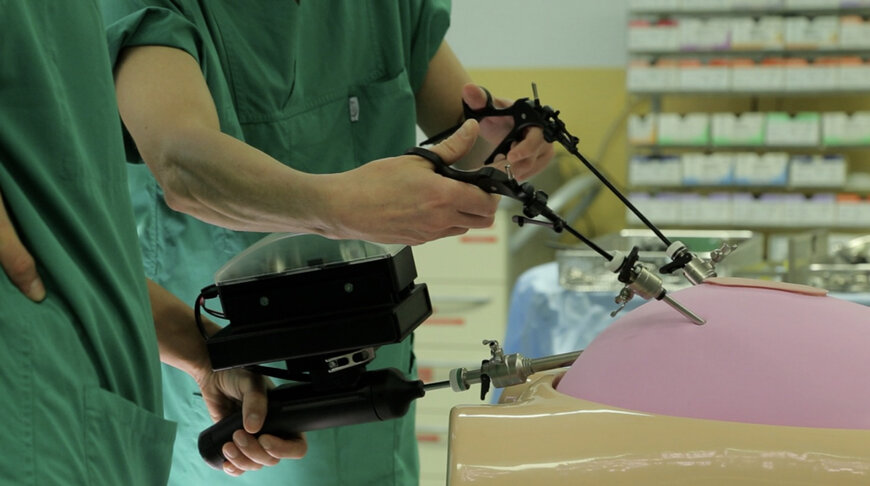
© Fraunhofer HHI: Optical wireless communication (LiFi) ensures robust data transfer from the endoscope to the monitor even under adverse conditions.
Researchers from Fraunhofer Heinrich Hertz Institute have developed a prototype wireless endoscope that transmits medical imaging data using light-based communication (LiFi), eliminating the need for conventional data cables in surgical environments.
The development is part of the OWIMED (Optical Wireless Communication for Medical Imaging Devices) project, conducted in collaboration with IT Concepts GmbH and St. Joseph Krankenhaus Berlin-Tempelhof.
Optical wireless communication in medical imaging
The system replaces traditional wired data transmission with LiFi technology, which uses modulated LED light to transmit data. Unlike radio-frequency communication, LiFi operates within a confined optical range, reducing interference and enhancing data security.
A modulator rapidly switches the LED light source on and off at frequencies not perceptible to the human eye. A photodiode receiver detects these light signals and converts them into electrical data for image reconstruction.
The system supports bidirectional communication, enabling both image transmission and remote control of endoscope camera settings.
Integration into surgical infrastructure
The LiFi modules are integrated into surgical lighting systems positioned above the operating table. This configuration ensures a direct line-of-sight communication path between the endoscope and the receiver.
The endoscope itself incorporates a battery-powered LED light source and a LiFi transmission module, removing the need for fiber-optic and data cables typically required in conventional systems.
Performance characteristics and data handling
The prototype supports high data rates suitable for transmitting 4K video streams from laparoscopic procedures. Integrated processing components, including a camera chip and microprocessor, enable low-latency data compression.
The LiFi modules provide hemispherical signal coverage over a 180-degree range, ensuring stable communication even with limited movement of the device during procedures.
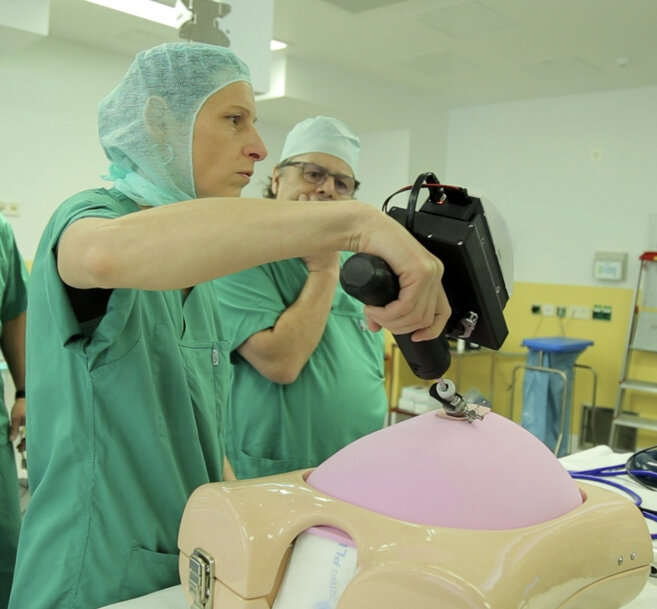
© Fraunhofer HHI: The medical staff of St. Joseph Krankenhaus use an OR simulator to test the wireless endoscope prototype in an operating room.
Operational advantages in surgical environments
Eliminating cables reduces physical obstructions in the operating room, improving workflow efficiency and reducing contamination risks. Conventional systems require multiple cables for lighting, power, and data transmission, which can complicate handling and sterilization.
The wireless configuration simplifies device handling and supports easier cleaning and disinfection processes.
Validation in clinical simulation
The prototype system was tested in a simulated operating room environment using a medical phantom. Evaluation focused on latency, reliability, data throughput, and ergonomic integration.
Testing confirmed stable performance across these parameters, with feedback indicating that the wireless system meets operational requirements for surgical use.
Implications for future medical devices
The LiFi-based approach demonstrates the feasibility of replacing wired communication in medical imaging systems with optical wireless technology. This supports the development of more flexible, scalable, and hygienic operating room environments.
The work by Fraunhofer Heinrich Hertz Institute highlights the potential of LiFi for high-reliability, low-latency applications in medical technology.
Edited by Natania Lyngdoh, Induportals Editor — Adapted by AI.
www.fraunhofer.com
Researchers from Fraunhofer Heinrich Hertz Institute have developed a prototype wireless endoscope that transmits medical imaging data using light-based communication (LiFi), eliminating the need for conventional data cables in surgical environments.
The development is part of the OWIMED (Optical Wireless Communication for Medical Imaging Devices) project, conducted in collaboration with IT Concepts GmbH and St. Joseph Krankenhaus Berlin-Tempelhof.
Optical wireless communication in medical imaging
The system replaces traditional wired data transmission with LiFi technology, which uses modulated LED light to transmit data. Unlike radio-frequency communication, LiFi operates within a confined optical range, reducing interference and enhancing data security.
A modulator rapidly switches the LED light source on and off at frequencies not perceptible to the human eye. A photodiode receiver detects these light signals and converts them into electrical data for image reconstruction.
The system supports bidirectional communication, enabling both image transmission and remote control of endoscope camera settings.
Integration into surgical infrastructure
The LiFi modules are integrated into surgical lighting systems positioned above the operating table. This configuration ensures a direct line-of-sight communication path between the endoscope and the receiver.
The endoscope itself incorporates a battery-powered LED light source and a LiFi transmission module, removing the need for fiber-optic and data cables typically required in conventional systems.
Performance characteristics and data handling
The prototype supports high data rates suitable for transmitting 4K video streams from laparoscopic procedures. Integrated processing components, including a camera chip and microprocessor, enable low-latency data compression.
The LiFi modules provide hemispherical signal coverage over a 180-degree range, ensuring stable communication even with limited movement of the device during procedures.
© Fraunhofer HHI: The medical staff of St. Joseph Krankenhaus use an OR simulator to test the wireless endoscope prototype in an operating room.
Operational advantages in surgical environments
Eliminating cables reduces physical obstructions in the operating room, improving workflow efficiency and reducing contamination risks. Conventional systems require multiple cables for lighting, power, and data transmission, which can complicate handling and sterilization.
The wireless configuration simplifies device handling and supports easier cleaning and disinfection processes.
Validation in clinical simulation
The prototype system was tested in a simulated operating room environment using a medical phantom. Evaluation focused on latency, reliability, data throughput, and ergonomic integration.
Testing confirmed stable performance across these parameters, with feedback indicating that the wireless system meets operational requirements for surgical use.
Implications for future medical devices
The LiFi-based approach demonstrates the feasibility of replacing wired communication in medical imaging systems with optical wireless technology. This supports the development of more flexible, scalable, and hygienic operating room environments.
The work by Fraunhofer Heinrich Hertz Institute highlights the potential of LiFi for high-reliability, low-latency applications in medical technology.
Edited by Natania Lyngdoh, Induportals Editor — Adapted by AI.
www.fraunhofer.com

