
www.medical-devices.tech
28
'26
Written on Modified on
Medical AI Systems for Clinical Deployment
Avalue Technology introduces integrated edge and backend platforms to enable scalable deployment of medical AI across imaging, surgery, and telemedicine workflows.
www.avalue.com
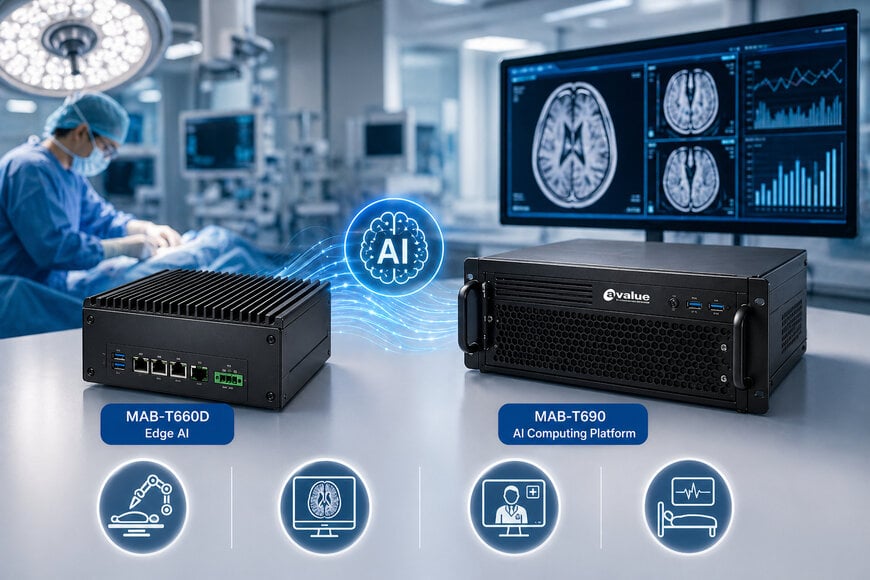
Avalue Technology has introduced two medical AI computing platforms designed to support end-to-end clinical deployment, combining high-performance backend processing with low-latency edge inference for healthcare environments.
Integrated Architecture for Clinical AI Deployment
The new systems address a common limitation in healthcare AI adoption: the gap between pilot projects and scalable, real-world implementation. By combining edge computing with centralized processing, the platforms form a distributed healthcare AI infrastructure capable of handling both real-time and high-load workloads.
The architecture links a backend system for intensive computation with an edge-based unit for on-site inference. This approach allows hospitals to process time-sensitive data locally while offloading complex workloads such as model training and multimodal data analysis to centralized systems.
Backend Platform for High-Performance Medical Computing
The MAB-T690 functions as the central processing unit within the architecture, designed for deployment in hospital data centers and research environments. It supports NVIDIA RTX Pro 5000 series GPUs and enables dual-GPU configurations, allowing workload distribution across multiple computational tasks.
This setup supports parallel processing of AI inference, medical image reconstruction, and large-scale data computation. It is particularly suited for high-resolution CT and MRI analysis, where large datasets and complex models require significant processing power.
The platform also supports multimodal data integration, combining imaging data with electronic health records. This capability is essential for developing advanced diagnostic models and enabling comprehensive clinical decision support systems.
Edge AI System for Real-Time Clinical Applications
The MAB-T660D is designed for deployment at the point of care, where low latency and system responsiveness are critical. Equipped with an NVIDIA RTX 2000E Ada GPU, it enables real-time AI inference directly within clinical environments.
By processing data locally, the system reduces dependency on cloud infrastructure and minimizes transmission delays. This is particularly relevant in applications such as surgical assistance and bedside monitoring, where immediate feedback is required.
The system includes PCIe Gen4 x16 expansion, enabling integration with medical devices such as frame grabbers and imaging systems. This allows direct data acquisition and processing within operating rooms, consultation areas, and intensive care units.
Compliance and Reliability in Clinical Environments
Both platforms are designed in accordance with IEC/EN 60601-1 medical electrical safety standards. Compliance with this standard ensures that the systems meet requirements for electrical safety and operational reliability in sensitive healthcare environments.
This is critical for deployment in settings such as operating theatres and ICUs, where equipment must function continuously and safely under strict regulatory conditions.
Application Scenarios Across Healthcare Workflows
The combined architecture supports a range of clinical use cases. In surgical environments, it enables real-time image analysis, navigation, and support for robotic-assisted procedures. In diagnostic imaging, it facilitates AI-assisted interpretation of CT and MRI scans with reduced processing time.
For telemedicine and remote diagnostics, the system supports stable data streaming and localized processing, improving responsiveness and reducing bandwidth requirements. In critical care, it enables continuous monitoring and early warning systems through real-time data analysis.
Enabling Scalable Medical AI Infrastructure
By integrating edge and centralized computing, the platforms provide a scalable framework for healthcare providers transitioning from experimental AI deployments to operational systems. The ability to distribute workloads between local and central resources supports efficient system utilization and improved performance.
This distributed approach reflects broader trends in edge AI in healthcare, where combining on-site processing with centralized computing enables faster, more reliable, and secure clinical applications.
Avalue Technology’s latest systems demonstrate how coordinated edge-to-core architectures can support the growing demand for high-performance, regulation-compliant computing in modern healthcare environments.
Edited by an industrial journalist Sucithra Mani with AI assistance.
www.avalue.com

