
www.medical-devices.tech
23
'26
Written on Modified on
Pharmaceutical cleaning systems for sterile container processing
Syntegon develops modular cleaning and depyrogenation technologies to support high-throughput, validated pharmaceutical production environments.
www.syntegon.com
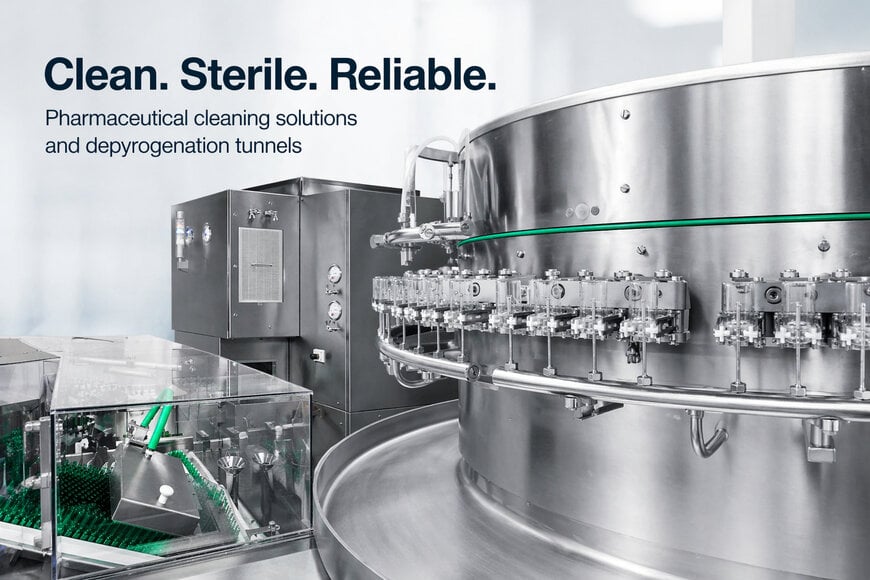
Pharmaceutical manufacturers require validated cleaning and sterilization processes to ensure container integrity and patient safety. Syntegon’s cleaning systems and depyrogenation tunnels address these requirements by combining high throughput, reproducibility, and flexible configuration for fill-finish operations.
Role of cleaning and sterilization in fill-finish processes
In pharmaceutical production, containers such as vials, ampoules, and cartridges must undergo multi-stage preparation before filling. This includes internal and external cleaning to remove particulate matter and residues, followed by drying, sterilization, and depyrogenation to eliminate microbial contamination and endotoxins.
These steps are mandatory for many drug products and must comply with strict regulatory expectations for validated, reproducible processes. At the same time, manufacturers must maintain high output rates while ensuring compatibility with sensitive formulations and container materials.
High-throughput cleaning with controlled process conditions
Syntegon’s RRN and RRU cleaning systems are designed for throughput levels of up to 36,000 containers per hour. The systems incorporate corrosion-resistant components, hose-free washing zones, and accessible surfaces to reduce contamination risks and support cleanability.
Process flexibility is enabled through configurable cleaning stations that can integrate different agents, high-pressure nozzles, or ultrasonic pre-treatment. This allows adaptation to varying contamination profiles and container geometries.
An external cleaning solution (RAN) is used after filling, particularly for high-potent drugs, to remove residues from container exteriors. This step reduces operator exposure and contributes to safer downstream handling within the pharmaceutical production environment.
Depyrogenation using dry heat and controlled airflow
For sterilization and endotoxin removal, Syntegon’s HQL depyrogenation tunnels apply dry heat based on the unidirectional airflow (UDAF) principle. This ensures uniform heat distribution and controlled particulate flow, supporting reproducible and validatable treatment conditions.
The integration of drying, sterilization, and depyrogenation within a single system reduces handling steps and limits contamination risks between process stages. Heat exchangers enable energy recovery, improving overall efficiency without compromising process stability.
Automated filter integrity testing and container transport systems reduce manual intervention, supporting consistent operation at industrial line speeds. These features are aligned with the requirements of a digital supply chain, where process data and automation enhance traceability and compliance.
Flexibility and modular system design
Both cleaning machines and depyrogenation tunnels are designed with modular architectures, allowing configuration according to container types, batch sizes, and production layouts. Adjustable stations and ergonomic access points enable rapid format changes, which is critical for manufacturers handling multiple product formats or small batch production.
This flexibility supports pharmaceutical and biotech companies in responding to changing market demands while maintaining validated process conditions.
Application scope and operational impact
The systems are used in pharmaceutical and biotechnology fill-finish lines where sterile processing is required, including injectable drugs and high-potency formulations. By combining high throughput with controlled and validated processes, the technologies support improved production efficiency while maintaining compliance with hygiene and safety standards.
Through integration of automation, energy recovery, and standardized processing steps, these solutions contribute to more reliable and scalable sterile manufacturing operations.
Edited by an industrial journalist Sucithra Mani with AI assistance.
www.syntegon.com

