
www.medical-devices.tech
13
'26
Written on Modified on
Photon-counting CT advances diagnostic imaging precision
Canon Inc. introduces Ultimion system to enhance imaging accuracy, spectral analysis, and clinical workflow efficiency in advanced healthcare environments.
global.medical.canon
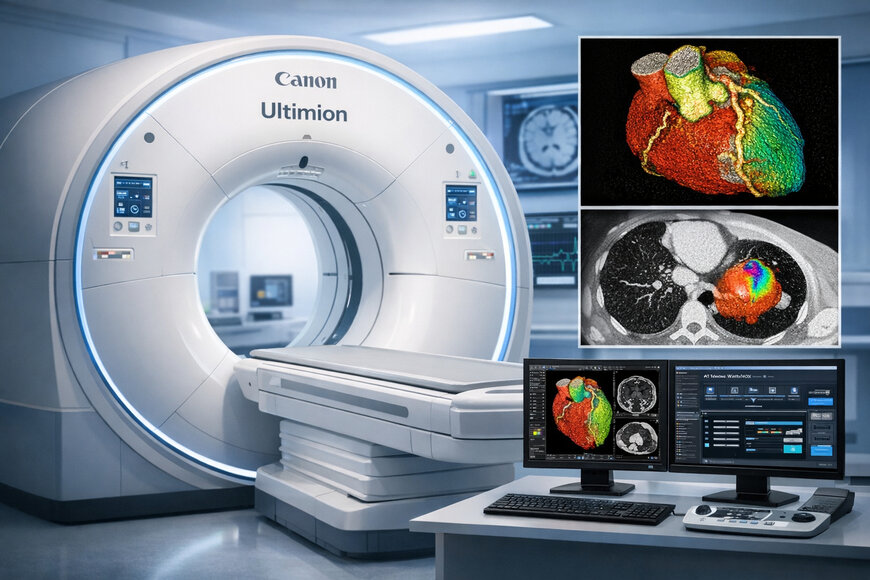
A new photon-counting CT system integrates high-resolution imaging, spectral analysis, and AI-supported workflows to improve diagnostic precision and operational efficiency across clinical applications such as oncology, cardiology, and musculoskeletal imaging.
Photon-counting technology and clinical relevance
Canon Inc. has introduced a domestically produced photon-counting CT system, marking a technological shift in computed tomography toward more precise X-ray detection. The system uses detectors capable of counting individual X-ray photons, enabling improved signal fidelity compared to conventional energy-integrating detectors.
This capability supports both ultra-high-resolution imaging and spectral imaging within a single scan. Spectral imaging enables differentiation between materials based on their energy-dependent attenuation characteristics, which is particularly relevant in oncology for tissue characterization and in cardiovascular imaging for plaque analysis.
The integration of these features aligns with the development of a more data-driven medical imaging ecosystem, where imaging systems contribute to a broader digital supply chain of diagnostic data and clinical decision-making.
Detector design and imaging performance
At the core of the system is a Cadmium Zinc Telluride (CZT) photon-counting detector, which directly converts X-ray photons into electrical signals. This approach improves dose efficiency and enhances lesion detectability by reducing electronic noise and enabling finer spatial resolution.
The system achieves a gantry rotation speed of 0.24 seconds per rotation, supporting rapid acquisition for dynamic studies such as cardiac imaging. Combined with Deep Learning Reconstruction (DLR), the system enables flexible imaging protocols across multiple clinical domains, including respiratory and musculoskeletal examinations.
AI-supported workflow and automation
The system incorporates an AI-based workflow platform, INSTINX, designed to streamline CT examinations. Automated patient positioning is enabled through integrated gantry cameras, while scan range selection is derived from positioning scan data.
Automated image layout and background processing further reduce manual intervention. Integration with picture archiving and communication systems (PACS) ensures that processed diagnostic data is available without interrupting clinical workflows.
This level of automation supports consistent imaging quality and reduces variability between operators, which is critical in high-throughput clinical environments.
Clinical validation and research integration
Development of the system is based on multi-year joint research conducted since 2020 with institutions in Japan, Europe, and the United States. Clinical research deployments compliant with regional regulatory requirements have contributed to validation of photon-counting CT in real-world settings.
Ongoing clinical research using the system began in March 2026 at the National Cancer Center Hospital East and the National Cancer Center Exploratory Oncology Research & Clinical Trial Center in Chiba, focusing on evaluating diagnostic performance and clinical utility.
Installation efficiency and operational impact
The system is designed for integration into existing clinical environments without requiring a dedicated chiller, reducing infrastructure modifications and installation complexity. This design supports faster deployment and improved utilization of imaging rooms.
By combining high-speed acquisition, reduced radiation dose potential, and automated workflows, the system is positioned to increase throughput while maintaining diagnostic quality.
Industry context and exhibition
The system is scheduled for presentation at the International Technical Exhibition of Medical Imaging 2026 (ITEM 2026), held at Pacifico Yokohama from April 17 to 19, 2026.
Photon-counting CT represents a measurable advancement over conventional CT systems, particularly in terms of spatial resolution, spectral capability, and dose efficiency. As clinical validation progresses, such systems are expected to play a growing role in precision diagnostics and advanced imaging workflows.
Edited by an industrial journalist Sucithra Mani with AI assistance.
www.global.medical.canon.com

