
www.medical-devices.tech
19
'26
Written on Modified on
Fraunhofer IPMS Develops Compact MEMS Laser Scan Module
Miniaturized pattern-scanning module enables precise beam control for ophthalmology and portable optical systems, improving treatment efficiency and system integration.
www.fraunhofer.de
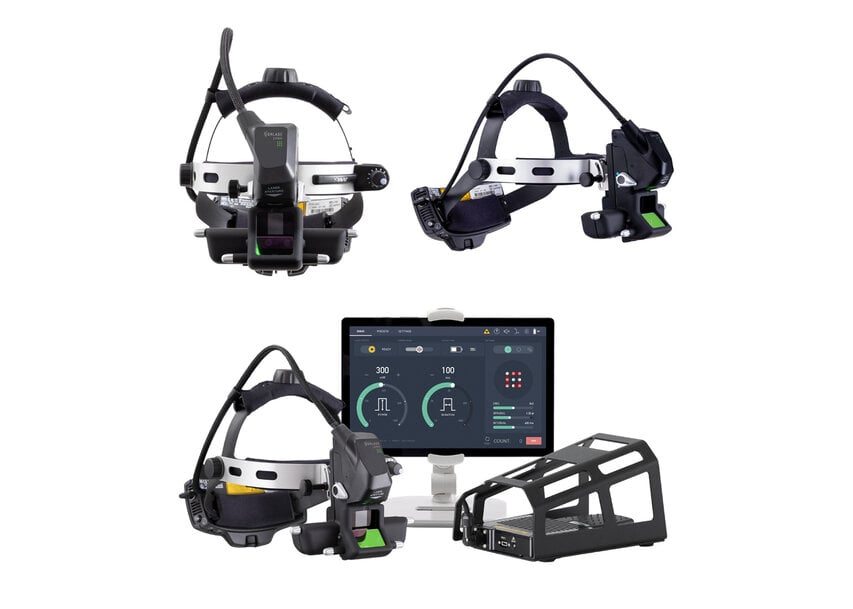
© Norlase: LYNX™ | Laser indirect ophthalmoscope with pattern scanning
Ophthalmology, medical laser systems, and optical diagnostics increasingly require compact, high-precision beam steering solutions, leading Fraunhofer Institute for Photonic Microsystems IPMS, in collaboration with Norlase ApS, to develop a MEMS-based laser scan module for pattern-scanning applications in retinal treatment and beyond.
The module, developed within the framework of the MultiLASE (Funding Code 01QE2136C) and UltraLASE (Funding Code 01QE2309C) projects under the Eurostars program, is designed to support highly compact laser systems by enabling rapid and accurate positioning of laser beams in predefined patterns. It will be exhibited at TOUCH Taiwan, from April 8–10, 2026, at booth M501.
MEMS-based beam steering for fast retinal treatments
The scan module integrates a two-dimensional quasi-static micro-scanning mirror capable of vectorial beam positioning. This enables pattern-scanning laser treatments to be performed in approximately one second, reducing procedure time compared to conventional point-by-point laser approaches.
Such performance is particularly relevant in retinal therapies, where shorter treatment durations can improve patient tolerance and reduce side effects. The system also supports improved targeting precision, which is critical for minimizing damage to surrounding tissue during laser procedures.
The module is designed for integration into compact ophthalmic devices such as Norlase’s LYNX system, which combines a semiconductor laser source with a scanning mechanism in a wearable format, enabling mobile and flexible treatment environments.
Integrated sensing and optical performance
A key technical feature of the module is the integration of position sensors directly within the MEMS mirror structure, enabling closed-loop control of beam positioning. This allows precise angle control, repeatability, and compensation for drift, which are essential for consistent treatment outcomes.
The mirror, with a diameter of 2.2 mm, is equipped with a high-reflectivity optical coating optimized for wavelengths between 450 and 600 nm. This supports efficient operation at higher laser power levels while maintaining optical throughput.
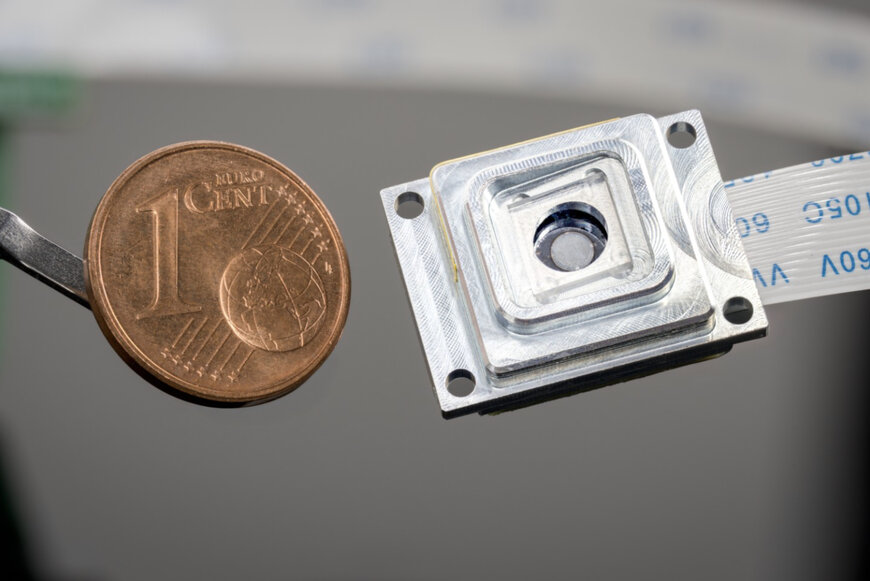
© Fraunhofer IPMS: Highly miniaturized vectorial micro-scanner module for use in ophthalmology.
The system provides a symmetric optical scan range of ±4° on both axes, enabling flexible beam steering for various scan patterns, including raster, line, dot, and spiral configurations. The actuator’s linear response also allows operation in both closed-loop and open-loop modes, simplifying integration into different control architectures.
Compact architecture for portable and embedded systems
The MEMS scan module is based on a non-gimbaled, quasi-static electrostatic comb-drive architecture, enabling compact form factors and low power consumption. The device is enclosed in a hermetic package that protects internal components from moisture and particulates, supporting long-term stability and reliability.
These characteristics make the module suitable for portable and handheld medical devices, where size, energy efficiency, and robustness are critical design constraints.
Expanding applications beyond ophthalmology
While optimized for pattern-scanning ophthalmic lasers, the module can also be applied in other optical systems requiring precise beam steering. These include optical coherence tomography (OCT), endoscopy, microscopy, and point-of-care diagnostic tools.
In addition, the technology can be used in industrial and sensing applications such as optical inspection, thickness measurement, LiDAR systems, free-space optical communication, and optical switching. By replacing conventional galvanometer scanners, the MEMS module enables reduced system size, lower power consumption, and simplified mechanical design.
Compared to traditional galvanometer-based scanning systems, which are typically larger and require more power, the MEMS-based approach offers a compact alternative with integrated sensing and flexible scan pattern capabilities, supporting the development of next-generation miniaturized optical devices.
Edited by Industrial Journalist, Natania Lyngdoh — Adapted by AI.
www.ipms.fraunhofer.com
Ophthalmology, medical laser systems, and optical diagnostics increasingly require compact, high-precision beam steering solutions, leading Fraunhofer Institute for Photonic Microsystems IPMS, in collaboration with Norlase ApS, to develop a MEMS-based laser scan module for pattern-scanning applications in retinal treatment and beyond.
The module, developed within the framework of the MultiLASE (Funding Code 01QE2136C) and UltraLASE (Funding Code 01QE2309C) projects under the Eurostars program, is designed to support highly compact laser systems by enabling rapid and accurate positioning of laser beams in predefined patterns. It will be exhibited at TOUCH Taiwan, from April 8–10, 2026, at booth M501.
MEMS-based beam steering for fast retinal treatments
The scan module integrates a two-dimensional quasi-static micro-scanning mirror capable of vectorial beam positioning. This enables pattern-scanning laser treatments to be performed in approximately one second, reducing procedure time compared to conventional point-by-point laser approaches.
Such performance is particularly relevant in retinal therapies, where shorter treatment durations can improve patient tolerance and reduce side effects. The system also supports improved targeting precision, which is critical for minimizing damage to surrounding tissue during laser procedures.
The module is designed for integration into compact ophthalmic devices such as Norlase’s LYNX system, which combines a semiconductor laser source with a scanning mechanism in a wearable format, enabling mobile and flexible treatment environments.
Integrated sensing and optical performance
A key technical feature of the module is the integration of position sensors directly within the MEMS mirror structure, enabling closed-loop control of beam positioning. This allows precise angle control, repeatability, and compensation for drift, which are essential for consistent treatment outcomes.
The mirror, with a diameter of 2.2 mm, is equipped with a high-reflectivity optical coating optimized for wavelengths between 450 and 600 nm. This supports efficient operation at higher laser power levels while maintaining optical throughput.
© Fraunhofer IPMS: Highly miniaturized vectorial micro-scanner module for use in ophthalmology.
The system provides a symmetric optical scan range of ±4° on both axes, enabling flexible beam steering for various scan patterns, including raster, line, dot, and spiral configurations. The actuator’s linear response also allows operation in both closed-loop and open-loop modes, simplifying integration into different control architectures.
Compact architecture for portable and embedded systems
The MEMS scan module is based on a non-gimbaled, quasi-static electrostatic comb-drive architecture, enabling compact form factors and low power consumption. The device is enclosed in a hermetic package that protects internal components from moisture and particulates, supporting long-term stability and reliability.
These characteristics make the module suitable for portable and handheld medical devices, where size, energy efficiency, and robustness are critical design constraints.
Expanding applications beyond ophthalmology
While optimized for pattern-scanning ophthalmic lasers, the module can also be applied in other optical systems requiring precise beam steering. These include optical coherence tomography (OCT), endoscopy, microscopy, and point-of-care diagnostic tools.
In addition, the technology can be used in industrial and sensing applications such as optical inspection, thickness measurement, LiDAR systems, free-space optical communication, and optical switching. By replacing conventional galvanometer scanners, the MEMS module enables reduced system size, lower power consumption, and simplified mechanical design.
Compared to traditional galvanometer-based scanning systems, which are typically larger and require more power, the MEMS-based approach offers a compact alternative with integrated sensing and flexible scan pattern capabilities, supporting the development of next-generation miniaturized optical devices.
Edited by Industrial Journalist, Natania Lyngdoh — Adapted by AI.
www.ipms.fraunhofer.com

