
www.medical-devices.tech
05
'26
Written on Modified on
AI-Enabled Medical Imaging Systems for Precision Diagnostics
GE HealthCare presents new imaging technologies at ECR 2026 to improve diagnostic accuracy, imaging efficiency, and data-driven clinical decision-making.
www.gehealthcare.com
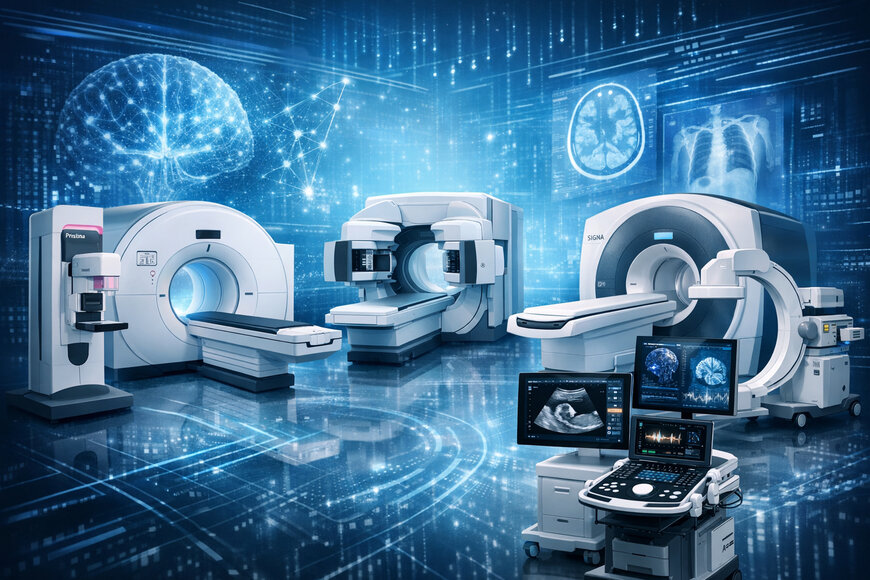
GE HealthCare presented a portfolio of advanced medical imaging systems at ECR 2026 in Vienna, highlighting new technologies in computed tomography, magnetic resonance imaging, molecular imaging, mammography, ultrasound, and interventional imaging designed to support precision care and workflow efficiency.
Imaging Innovation in Precision Healthcare
Healthcare systems are experiencing rising imaging volumes, workforce shortages, and increasing diagnostic complexity. Medical imaging technologies are therefore evolving toward automation, artificial intelligence integration, and cloud-connected data environments that support faster clinical decision-making.
At the European Congress of Radiology (ECR) 2026, held in Vienna, GE HealthCare introduced seven imaging technologies intended to improve diagnostic performance, optimize workflows, and enhance operational efficiency across radiology departments. The systems span multiple modalities, including CT, MRI, SPECT/CT, PET/CT, mammography, ultrasound, and image-guided therapy.
The innovations presented at the event reflect a broader research and development program supported by approximately $5.1 billion in investment since the company’s spin-off in 2023. Many of the technologies combine advanced detector hardware with AI-based analysis and cloud-enabled imaging workflows.
Total-Body PET/CT for Oncology and Clinical Research
One of the systems presented at ECR 2026 is the Omni 128 cm total-body PET/CT scanner. The system is designed to capture metabolic activity across the entire body using positron emission tomography combined with computed tomography.
Total-body PET imaging enables simultaneous visualization of multiple organs and biological processes, which can improve disease staging and treatment monitoring in oncology. The 128 cm axial field-of-view allows broader anatomical coverage compared with conventional PET systems, enabling studies of systemic diseases and supporting research into new radiotracers and theranostic agents.
The system carries CE marking for use within the European Union but has not been cleared by the U.S. Food and Drug Administration.
Digital 4D SPECT/CT Imaging
The StarGuide GX system represents a digital 4D SPECT/CT platform designed for nuclear medicine imaging. SPECT/CT combines single-photon emission computed tomography with CT imaging to provide both functional and anatomical information.
Digital detector technologies enable improved photon detection efficiency and image reconstruction capabilities, which can support higher diagnostic sensitivity and improved quantification of radiopharmaceutical uptake. Such capabilities are particularly relevant for applications in oncology, cardiology, and neurological imaging.
StarGuide GX is CE marked but has not received regulatory clearance in the United States.
Spectral Counting CT and Advanced Detector Technology
Photon-counting CT represents a new generation of CT imaging technology capable of measuring X-ray photon energy levels individually rather than integrating them into broad energy bands.
GE HealthCare’s Photonova Spectra system introduces spectral counting CT with eight energy bins for improved material differentiation and image contrast. The system is built on proprietary Deep Silicon detector technology designed to improve photon detection efficiency and enable higher-resolution spectral imaging.
Spectral CT techniques allow clinicians to differentiate tissues and materials based on energy signatures, supporting applications in neurological imaging, oncology assessment, musculoskeletal diagnostics, thoracic imaging, and cardiac examinations. The system is currently pending regulatory clearance in the United States and has not yet received CE marking.
MRI Systems with AI-Driven Workflow Automation
GE HealthCare also presented new magnetic resonance imaging systems intended to improve operational efficiency and expand access to MRI diagnostics.
The SIGNA Sprint system uses a sealed magnet configuration designed to reduce infrastructure requirements while maintaining 1.5-tesla imaging performance. This configuration may enable MRI deployment in facilities with limited technical infrastructure, including remote healthcare environments.
The SIGNA Bolt system introduces a 3-tesla MRI scanner designed for advanced imaging applications and research environments requiring higher magnetic field strength.
Both systems integrate SIGNA One, an AI-driven workflow ecosystem designed to support exam planning, acquisition optimization, and automated processing. AI-assisted imaging workflows can help reduce scan times and improve exam consistency across clinical settings.
Deep Learning Reconstruction for Mammography
Pristina Recon DL introduces a reconstruction approach for digital breast tomosynthesis (DBT) that combines deep learning algorithms with iterative reconstruction methods.
Digital breast tomosynthesis produces three-dimensional representations of breast tissue by combining multiple low-dose X-ray projections. Reconstruction algorithms determine the final image quality and diagnostic visibility.
By integrating deep learning with iterative reconstruction, the system aims to improve image clarity while maintaining patient radiation dose levels consistent with screening standards. The technology is CE marked and has received regulatory authorization in the United States.
Interventional Imaging and Mobile C-Arm Systems
The Allia Moveo system expands the Allia interventional imaging platform with a compact, cable-free C-arm configuration designed for catheter-based procedures and minimally invasive surgery.
C-arm imaging systems provide real-time fluoroscopic guidance during cardiovascular, vascular, and non-vascular procedures. A mobile and compact design can help clinicians operate within space-constrained interventional suites.
The platform integrates AI-supported guidance tools and an intuitive interface designed to assist procedural workflows and improve positioning accuracy during interventions.
AI-Enabled Ultrasound Systems
GE HealthCare also introduced the latest generation of LOGIQ ultrasound systems for general diagnostic imaging. Ultrasound systems remain widely used across radiology, obstetrics, cardiology, and emergency medicine due to their real-time imaging capabilities and absence of ionizing radiation.
The new systems incorporate AI-assisted automation for image acquisition and measurement tasks. Automated workflow tools can reduce manual adjustments during exams and support standardized image capture, which is important for reproducibility in diagnostic imaging.
The ultrasound platform also incorporates an open digital architecture intended to support integration with hospital information systems and cloud-based imaging environments.
Advancing the Medical Imaging Data Ecosystem
The technologies presented at ECR 2026 illustrate a broader shift toward connected imaging platforms in which AI analysis, advanced detector hardware, and cloud-enabled infrastructure operate within an integrated medical imaging data ecosystem.
By combining automated workflows, high-resolution imaging hardware, and advanced data processing, these systems aim to support radiologists and clinicians in managing increasing diagnostic workloads while maintaining image quality and diagnostic confidence.
Such developments reflect ongoing efforts in radiology to integrate imaging data, clinical information, and computational analysis into unified precision care environments capable of supporting more personalized patient treatment pathways.
www.gehealthcare.com

