
www.medical-devices.tech
27
'26
Written on Modified on
Pharmaceutical manufacturers advanced aseptic filling automation
At INTERPHEX 2026, pharmaceutical and biotech companies will implement automated fill-finish, inspection, and assembly solutions to meet Annex 1 and enable scalable production.
www.syntegon.com
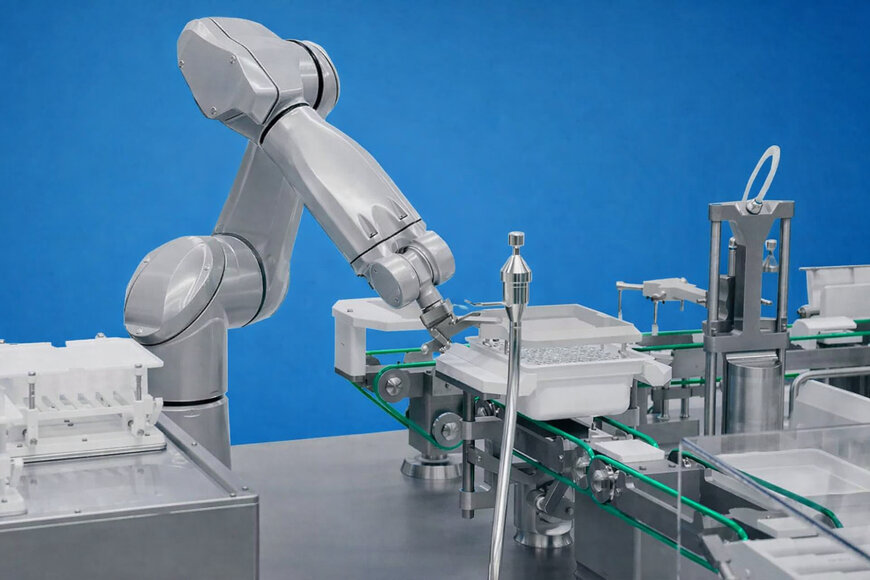
INTERPHEX 2026 will take place from April 21–23, 2026, at the Javits Center in New York City. The event will focus on how pharmaceutical and biotech manufacturers are responding to tightening regulatory requirements and increasing demand for high-value therapeutics.
Compliance with EU GMP Annex 1 in aseptic manufacturing remains a primary investment driver. At the same time, companies are seeking higher output, reduced operator intervention, faster scale-up, and improved technology transfer from development to commercial production.
Annex 1 compliance in aseptic fill-finish
Manufacturers upgrading sterile liquid and lyophilized filling lines are expected to prioritize minimizing human intervention in critical zones. To achieve this, companies will deploy automated filling platforms integrating gloveless isolators and contactless transport systems.
By increasing automation at high production speeds, these systems are designed to reduce contamination risk and support Annex 1 readiness without extensive retrofits. Lower manual interaction is intended to simplify environmental monitoring strategies and strengthen sterility assurance levels in commercial-scale operations.
The platform was developed in cooperation with multinational pharmaceutical partners, aligning equipment design with current GMP expectations.
Integrated vial processing to reduce interface complexity
For vial filling operations, manufacturers are expected to address recurring challenges linked to multiple equipment interfaces between filling machines, isolators, loading systems, and freeze-dryers.
By implementing integrated vial processing lines from a single supplier portfolio, companies aim to reduce mechanical and software interfaces. This approach is intended to simplify qualification and validation procedures while lowering product risk at transfer points.
Such integration is particularly relevant for biologics and other high-value injectables, where sterility and process continuity are critical.
Offline visual inspection to avoid production interruptions
Automatic visual inspection systems remain central to pharmaceutical quality control. However, developing or adjusting inspection recipes directly on production lines can interrupt output.
To avoid downtime, manufacturers will introduce offline inspection units capable of replicating full production conditions, including camera configuration, lighting, vision systems, and spinning parameters. This will allow engineers to build and fine-tune inspection recipes without halting commercial manufacturing.
Once finalized, recipes can be validated and transferred directly to production-scale visual inspection systems, improving operational efficiency and reducing changeover-related losses.
Scalable assembly for GLP-1 injectable therapies
The expansion of GLP-1-based anti-obesity and diabetes treatments is increasing demand for flexible assembly systems for injectable delivery devices.
Pharmaceutical companies and CDMOs are expected to deploy semi-automated assembly platforms for clinical and early commercial production. These systems are designed for GMP compliance and operator-friendly handling while ensuring compatibility with fully automated high-throughput lines.
This continuity supports smoother technology transfer, reduces redevelopment effort during scale-up, and maintains consistent process parameters across lifecycle phases.
Oral solid dosage: predictable scale-up
In oral solid dosage production, transferring granulation processes from laboratory to global scale can introduce variability.
Manufacturers will address this by implementing laboratory mixers equipped with the same impeller geometry as production-scale high-shear mixers. The alignment of core process technology is intended to improve scale-up predictability and reduce reformulation risks.
Complementary laboratory systems for feasibility studies and design of experiments (DoE), combined with open recipe management within control systems, support documentation, reproducibility, and regulatory compliance.
Lifecycle support and industry exchange
Beyond equipment deployment, pharmaceutical manufacturers are increasingly requiring lifecycle services including spare parts management, maintenance strategies, digital monitoring solutions, and system upgrades.
During panel discussions at INTERPHEX 2026, industry experts will address future growth in pharmaceuticals and scalable injectable device manufacturing, reflecting the sector’s strategic focus on automation, regulatory compliance, and flexible production architectures.
Across aseptic filling, visual inspection systems, injectable device assembly, and oral solid dosage manufacturing, companies are expected to prioritize automation, integration, and scalable design to meet regulatory requirements while safeguarding productivity and product quality.
www.syntegon.com

