
www.medical-devices.tech
05
'26
Written on Modified on
3D Camera Enables Automated Ultrasound Position Documentation
Fraunhofer Researchers are developing a camera-based system that automatically records the spatial position and angle of ultrasound scans on the patient’s body.
www.fraunhofer.de
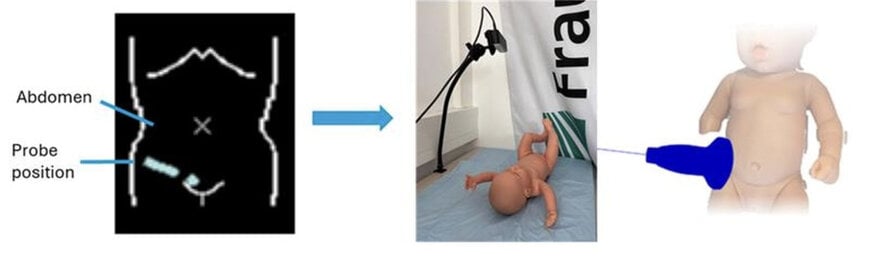
Pediatric imaging and clinical ultrasound diagnostics rely heavily on ultrasound to avoid radiation exposure, particularly in children. While the imaging itself is well established, the documentation of where and how an ultrasound scan was recorded on the body remains largely manual, time-consuming, and prone to inaccuracies. This gap affects clinical workflows, follow-up examinations, and the reproducibility of findings.
Researchers at Fraunhofer Institute for Manufacturing Engineering and Automation IPA are addressing this challenge with an automated documentation system that records the spatial position and orientation of ultrasound scans relative to the patient’s body.
Reducing manual effort in clinical workflows
In current clinical practice, findings such as cysts or tumors detected during pediatric ultrasound examinations must be manually measured and documented. Physicians typically transfer the probe position to a two-dimensional pictogram on the ultrasound system, a process that can account for up to a quarter of examination time and introduces potential documentation errors.
The new approach, developed within the SonoMap research project, replaces manual input with automated spatial capture. A 3D camera detects the ultrasound probe and simultaneously measures the patient’s body surface. AI-based image processing algorithms then determine the probe’s position and angle and relate it to an abstracted three-dimensional body model.
Three-dimensional visualization with orientation data
Unlike conventional documentation methods, the system captures not only the scan location but also the angle and orientation of the probe during image acquisition. This additional spatial information is relevant because the viewing angle influences how anatomical structures appear in ultrasound images. Recording tilt and orientation can therefore support more precise localization of findings and improve the comparability of follow-up examinations.
The generated 3D visualization can be rotated and stored, allowing clinicians to review the examination from different perspectives without additional manual documentation steps. Once the ultrasound image is saved, the spatial documentation is created automatically.
From demonstrator to clinical validation
A functional demonstrator of the system has already been completed. The next step involves clinical evaluation, for which a study application has been submitted. Parallel work focuses on ensuring that the 3D camera captures only the information required for spatial documentation, addressing patient data protection requirements.
Following clinical validation, the researchers aim to collaborate with industry partners to integrate the technology into commercial ultrasound systems. The approach targets increased documentation accuracy, reduced workload for clinical staff, and improved efficiency in pediatric ultrasound diagnostics.
www.fraunhofer.com

