
www.medical-devices.tech
27
'26
Written on Modified on
Semi-Continuous OSD Manufacturing Platform for Pharmaceuticals
Syntegon Xelum processes APIs as traceable X-Key subbatches through granulation, compression or encapsulation, combining continuous efficiency with batch traceability without scale-up.
www.syntegon.com
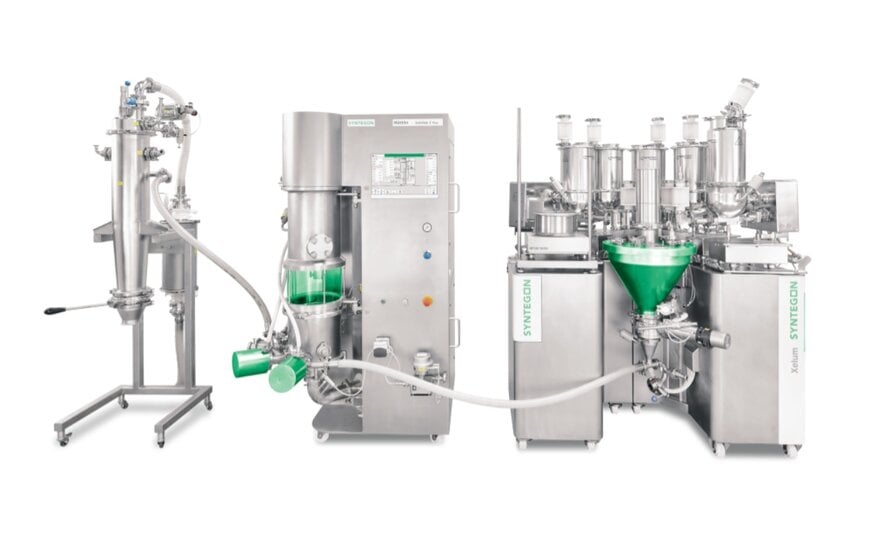
Continuous manufacturing of oral solid dosage forms (OSD) can shorten development, reduce active ingredient consumption and remove loading and unloading steps, but constant mass flows complicate precise dosing and traceability, and a malfunction can lead to high reject rates. Syntegon addresses this with Xelum, a semi-continuous OSD platform that combines the efficiency of continuous production with the traceability of batch processes.
Challenges of Continuous OSD Manufacturing
Guidelines such as ICH Q13 provide a global regulatory framework for continuous manufacturing. In practice, however, processes still have to be redefined and validated during scale-up, and quality assurance often requires complex process analytical technologies (PAT). These factors become a cost and risk issue, particularly with expensive and highly potent active pharmaceutical ingredients (HPAPIs).
How X-Keys Enable Traceable Semi-Continuous Processing
Xelum guides active ingredients and excipients through the process as discrete subbatches called X-Keys. Each X-Key is traceable through a digital fingerprint containing all relevant process parameters, quality attributes and raw material batch numbers. An intelligent control system automatically keeps the process within set specifications, so complex PAT systems are not required. As in continuous manufacturing, X-Keys pass from dosing, granulation and drying to tableting or encapsulation automatically and without intermediate storage, which shortens lead time and increases plant efficiency. Fluid-bed granulation, direct compression and encapsulation are all possible on the platform.
Fluid-Bed Technology and Scale-Out Instead of Scale-Up
Xelum is based on Syntegon's fluid bed technology, in which granulation and drying take place in the same chamber, eliminating the transfer of wet granules. According to Syntegon, this produces granules with a unimodal particle size distribution and good flow and tableting properties at high product yield. Processes developed on the Solidlab 2 Plus laboratory unit can be transferred to production by scale-out, because the Xelum R&D and pilot line use the same fluid bed system as the production platform. Development runs start from 250 g; in production, throughput ranges from 1 to 30 kg/h for granulation, 50 to 100 kg/h for direct compression and 50 to 100 kg/h for encapsulation, depending on product and formulation.
Dosing Precision and Containment for HPAPIs
The defined X-Keys allow precise dosing down to an API concentration of 0.25%, without remixing to compensate for dosing fluctuations. Because the system reaches steady state without a ramp-up phase, start-up and shutdown losses are eliminated. Containment options up to OEB 4 are available. Syntegon supports the lifecycle from process consulting and laboratory testing at its OSD centres to qualification, training, maintenance and digital services.
Additional Context
This section details technical specifications and competitive benchmarking not included in the original product announcement.
ICH Q13, adopted by the International Council for Harmonisation in 2022, defines scientific and regulatory considerations for continuous manufacturing of drug substances and drug products, including control strategy and batch definition. Fully continuous OSD lines from other suppliers, such as GEA's ConsiGma platform, typically use twin-screw wet granulation with continuous material flow, whereas Xelum uses fluid-bed processing of discrete subbatches. Occupational exposure bands such as OEB 4 generally correspond to exposure limits in the low single-digit microgram per cubic metre range, which defines the containment level required for potent compounds. Syntegon has not published comparative yield or reject-rate data in this article.
Edited by Evgeny Churilov, Induportals Media - Adapted by AI.
www.syntegon.com

