
www.medical-devices.tech
26
'26
Written on Modified on
Photon-Counting CT for Ultra-High-Resolution Spectral Imaging
Canon will present its Ultimion photon-counting CT system and Penn Medicine research results at RSNA 2026 in Chicago.
global.medical.canon
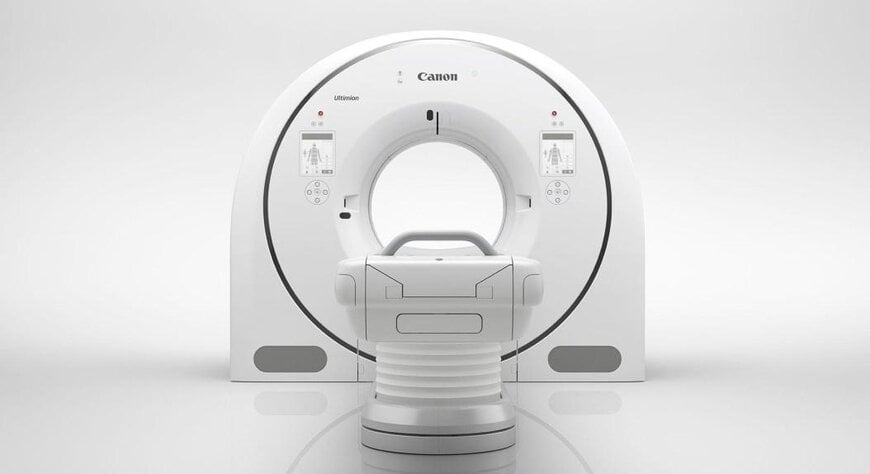
Canon will exhibit its Ultimion photon-counting CT (PCCT) system at the annual meeting of the Radiological Society of North America (RSNA 2026), held in Chicago from 29 November to 3 December 2026, marking the system's first international exhibition appearance. Canon will present the scanner's ultra-high-resolution and spectral imaging capabilities, selected clinical cases and research findings from its collaboration with Penn Medicine, with applications in cardiovascular, respiratory and musculoskeletal imaging.
Core Technology and System Architecture
Conventional energy-integrating CT detectors convert X-rays into light before measuring a combined signal, which limits spatial resolution and discards energy information. Ultimion instead uses a cadmium zinc telluride (CZT) photon-counting detector that registers each incident X-ray photon individually. Because photon energy is measured directly, the system acquires ultra-high-resolution and spectral images in a single acquisition, with both capabilities always enabled. Spectral data can be used to differentiate a wide range of substances. A robust frame supports a maximum gantry rotation speed of 0.24 seconds per rotation, while Deep Learning Reconstruction (DLR) and a new X-ray tube adapted to photon-counting characteristics allow flexible scan conditions.
Deployment and Implementation
Workflow integration is handled by INSTINX, Canon's data-processing and automation technology developed using AI. Gantry cameras support automated one-touch patient positioning, the scan range can be set automatically from the positioning scan, and images are laid out automatically. Linked to a Canon workstation, the system processes diagnostic information in the background and transfers it to the picture archiving and communication system (PACS). As no chiller is required, the scanner can be installed in existing examination rooms with fewer modifications.
Ultimion was launched in Japan in April 2026. A unit installed at Penn Medicine in May 2026 became the first Canon commercial PCCT system to undergo clinical evaluation in the United States after regulatory approval in Japan. Research there continues while the system awaits U.S. FDA clearance, and Ultimion is not currently available for sale outside Japan.
Industry Applications
Penn Medicine researchers and Canon scientists have worked side by side for several years on study design, protocol development, image reconstruction and clinical evaluation, with studies covering cardiovascular imaging, dose efficiency, spectral imaging and ultra-high-resolution imaging.
"We have been very pleased with the high-resolution image quality that Ultimion delivers with full detector width acquisition in cardiovascular imaging, particularly in patients with heavy calcification and stents, where conventional CT reaches its limits," said Harold I. Litt, MD, PhD, Professor of Radiology at the Perelman School of Medicine at the University of Pennsylvania.
Operational Impact and Performance Metrics
The system is designed to support low-dose imaging, diagnostic confidence and workflow productivity. Combining resolution and spectral information in one acquisition reduces the need for separate scans, while automated positioning and background processing keep workflows close to those of conventional CT.
"Features such as ultra-high resolution, combined with advanced reconstruction methods, can extend the clinical capabilities we offer our patients," said Peter B. Noël, PhD, Professor of Radiology and Director of CT Research at the Perelman School of Medicine at the University of Pennsylvania.
Edited by Natania Lyngdoh, Induportals editor, with AI assistance.
www.canon.com

