
www.medical-devices.tech
19
'26
Written on Modified on
Robotic-Assisted Surgery System Cleared for General Surgery
Medtronic receives U.S. FDA 510(k) clearance extending the Hugo RAS system from urology to upper and lower abdominal general surgery procedures.
www.medtronic.com
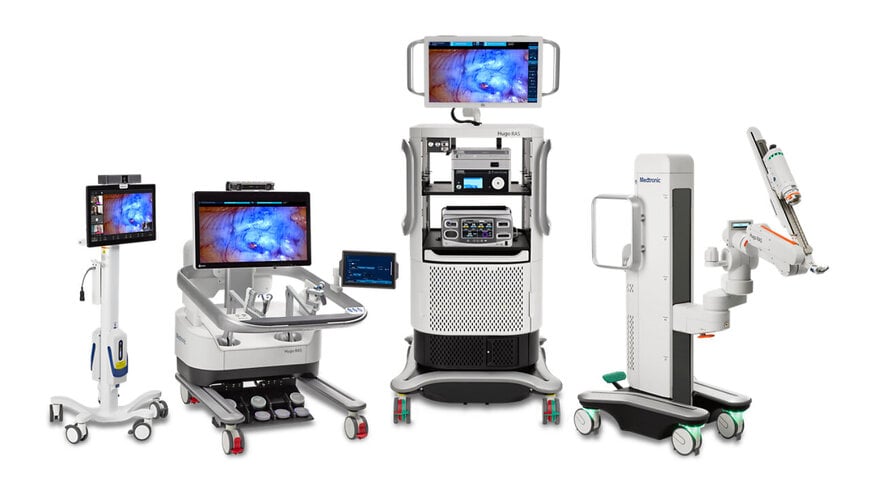
Hospitals adopting robotic-assisted surgery face the question of how many procedure types a single platform can support, since system utilisation determines the economic case. Medtronic plc has received an expanded U.S. 510(k) clearance from the Food and Drug Administration (FDA) for the Hugo robotic-assisted surgery (RAS) system in general surgery, one of the fastest-growing areas of robotic surgery in the United States.
Scope of the Clearance
The clearance covers all upper abdominal general surgical procedures, including but not limited to cholecystectomy, Roux-en-Y gastric bypass, ventral hernia repair and small bowel resection. It also includes two lower abdominal procedures, inguinal hernia repair and appendectomy. Together these procedures account for about 3.5 million surgeries in the United States each year, more than half of all soft-tissue procedures performed annually. For U.S. hospitals, the clearance extends Hugo beyond its previously cleared urology indications.
System Design and Instrumentation
Hugo has a modular architecture: surgical teams use only the number of robotic arms a procedure requires and position them according to the surgical technique and the patient's anatomy. An open console keeps the surgeon in visual and verbal contact with the operating room team and the patient. Surgeons can also use the LigaSure RAS Maryland instrument, which brings Medtronic's vessel-sealing technology, used in more than 45 million open and laparoscopic procedures, to the robotic platform.
"Hugo expands choice with a practical option to help hospitals address capacity and access challenges," said Matt Anderson, senior vice president and president of Medtronic's Surgical business.
Clinical Adoption
Hugo is in clinical use at a growing number of U.S. health systems and hospitals. Globally, Hugo procedure volume is growing at more than twice the rate of the robotic surgery market and is on track to exceed 50,000 procedures by the end of Medtronic's fiscal year. Outside the United States, general surgery has become the system's fastest-growing specialty, ahead of urology and gynaecology.
"Expanding our robotic-assisted surgical capabilities with the Hugo RAS system allows us to offer additional treatment options," said Dr. Francesco Bianco, surgeon at UI Health and professor of surgery at the University of Illinois College of Medicine. He also pointed to the system's role in surgical education and training.
Additional Context
This section details technical specifications and competitive benchmarking not included in the original product announcement.
A 510(k) premarket notification requires a manufacturer to demonstrate that a device is substantially equivalent to a legally marketed predicate device; expanded clearances add indications for use to an existing device. In general surgery, procedures such as cholecystectomy and hernia repair are performed in high volumes, which makes them important for the utilisation of robotic systems in hospitals. Modular, cart-based arm designs allow arm count and placement to be adapted to each procedure, whereas single-boom systems mount all arms on one patient-side unit.
Edited by Evgeny Churilov, Induportals Media - Adapted by AI.
www.medtronic.com

