
www.medical-devices.tech
01
'26
Written on Modified on
Automated Mobile Robotics for Clinical Intralogistics Systems
NEURA Robotics introduces an AI-driven healthcare platform designed to streamline hospital infrastructure by automating the transport of empty beds and sterile supplies.
neura-robotics.com
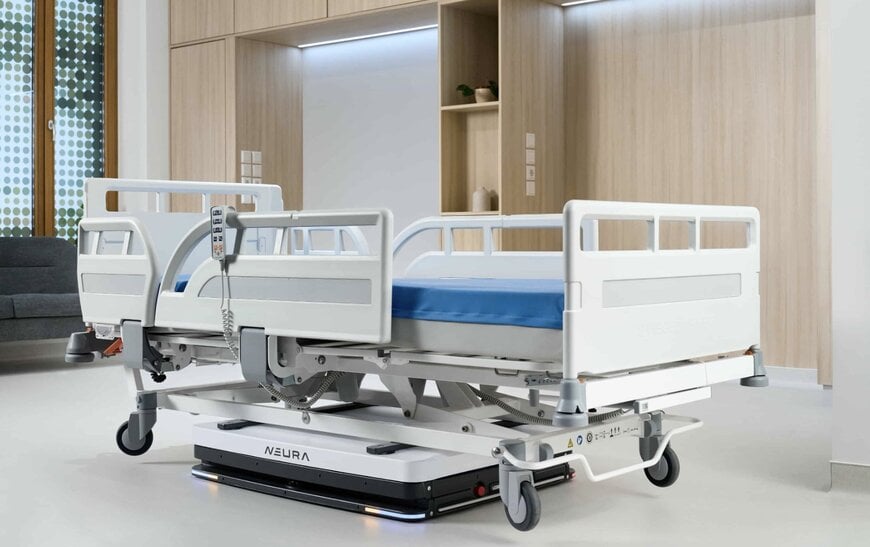
NEURA Robotics has released its Healthcare Platform, an autonomous mobile robot system engineered to automate material handling within clinical environments. By transferring routine logistical tasks away from nursing staff, this automated clinical intralogistics solution addresses structural capacity limitations across the healthcare and medical technology sectors.
Addressing Capacity Constraints with Omnidirectional Robotics
According to World Health Organization projections, the European Union faces a shortage of 4.1 million healthcare workers by 2030. To mitigate these capacity limitations, the Healthcare Platform automates the movement of empty beds and sterile supplies between wards, floors, and storage areas. The autonomous mobile robot features a flat, omnidirectional chassis capable of rotating on its own axis, allowing it to navigate narrow hospital corridors and maneuver out of restricted patient rooms. By maintaining active safety features during the lifting and transport phases, the system handles an estimated 20 trips per day. This operational output frees up more than 1,300 working hours annually, reallocating that time directly to patient care.
Sensor Integration within a Healthcare Robotics Ecosystem
The mobile robots operate within Neuraverse, an open physical artificial intelligence architecture that functions as a comprehensive healthcare robotics ecosystem. In a sensor-enabled hospital, this platform aggregates spatial and device data to autonomously assign tasks to the robotic units without requiring manual dispatching. The system relies on cognitive robotics to perceive clinical environments and continuously adapt its navigation algorithms with each use. Following this initial rollout, the newly formed NEURA HealthTech division plans to expand the platform with MAiRA, a cognitive robotic arm for instrument intralogistics, and MiPA, an intelligent service robot currently undergoing training for patient room support and medication administration. According to CEO David Reger, implementing physical AI aims to relieve the physical burden on caregivers by shifting highly repetitive tasks to automated systems.
Deployment Protocols and Clinical Validation
Engineered specifically for medical infrastructure, the system enforces strict hygiene and clinical safety standards by restricting transport exclusively to empty beds. Prior to commissioning, the robotic navigation is validated against precise facility floor plans, mapping corridor widths, door clearances, and elevator dimensions. The technology is deployed via a Robotics-as-a-Service (RaaS) model, converting capital expenditures into predictable operational costs. Facilities pay a fixed monthly fee that covers system integration, operation, maintenance, continuous software updates, and secure data hosting within a European cloud infrastructure. The hardware and software ecosystem was demonstrated by integration partner AURONIQ ROBOTICS at the Smart Health Automation Summit of VDMA HealthTech on September 29 and 30, 2026, in Düsseldorf.
Additional Context
This section details technical specifications and competitive benchmarking not included in the original news release.
In the clinical autonomous mobile robot (AMR) market, systems are primarily evaluated on payload capacity, turning radius, and spatial footprint. The NEURA Healthcare Platform competes with established medical intralogistics solutions such as the Aethon TUG and standard Mobile Industrial Robots (MiR) platforms fitted with top modules. While traditional hospital AMRs frequently utilize a differential-drive mechanism that requires a wider turning radius to change direction, NEURA’s integration of an omnidirectional drive allows for a zero-degree turning radius. This omnidirectional capability, combined with an ultra-low profile designed to drive directly underneath hospital beds before lifting them, permits navigation in tighter clinical corridors than standard towing or cart-pushing robots.
Edited by Aishwarya Mambet, Induportals Editor, with AI assistance.
www.neura-robotics.com

