
www.medical-devices.tech
01
'26
Written on Modified on
Automated Bioreactor Infrastructure for Scalable Cell Therapy Production
By integrating Rockwell Automation control architectures, PBS Biotech transitions processing steps from laboratory environments to commercial phases.
www.rockwellautomation.com
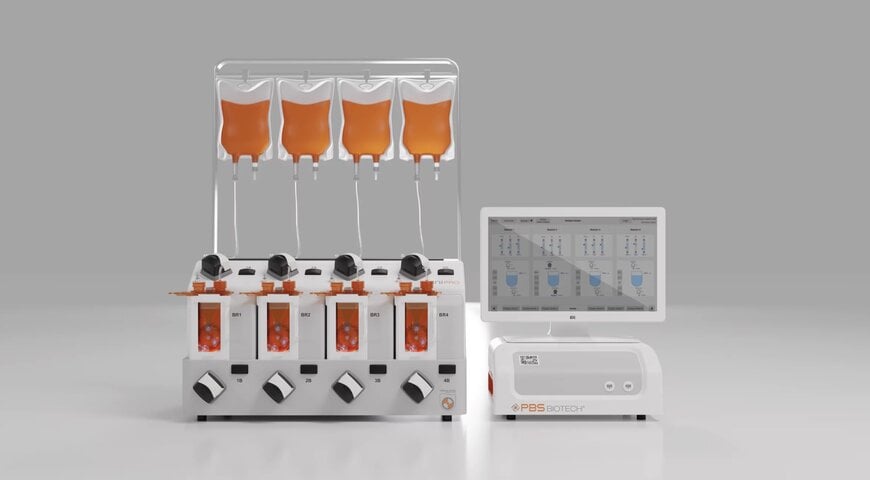
PBS Biotech, a manufacturer of single-use biological equipment, partnered with automation provider Rockwell Automation to integrate standardized control platforms into its multi-parallel bioreactor units. This collaboration establishes consistent data and process control within the advanced therapy medicinal product (ATMP) sector.
Overcoming Development Bottlenecks in Advanced Therapies
Manufacturers operating in the ATMP sector face the operational challenge of accelerating process development while maintaining strict regulatory compliance, reproducibility, and scalability. Historically, the sector has relied on slow iterative workflows, manual interventions, and PC-based or proprietary operational systems. These methods introduce high variability and increase operational risks as therapies progress from clinical trials toward commercialization. Recognizing these limitations, PBS Biotech sought a method to standardize the operational environment of its equipment to help end-users transition smoothly to commercial production scales.
Implementing Standardized Process Control
To resolve these technical bottlenecks, PBS Biotech integrated a standardized, globally recognized automation solution into its MiniPRO platform. The resulting system is a closed, automated bioreactor infrastructure capable of accommodating up to 24 independently controlled bioreactors for parallel process development.
The technical solution leverages process library software to provide integrated, real-time process control and visibility within a scalable automation environment. This architecture allows the compact bioreactor platform to integrate directly with larger distributed control systems (DCS), effectively extending the same automation framework across an entire cell therapy manufacturing site.
Technical Advantages and System Integration
The primary technical advantage of this integration is the ability to apply industrial-scale data acquisition and process control to early-stage development. By utilizing standardized controllers rather than isolated, proprietary software, operators can ensure that data collected during the research phase translates directly to commercial phases.
Sharon Harvey, Director of Product Management and Strategy at PBS Biotech, explains the operational impact of this architecture: “Industrial-grade quality control over critical process parameters enables users to generate high-quality process data in an environment that replicates commercial production conditions. Developers can adopt this approach from the product development phase and then scale up to clinical and commercial production, leveraging historical data and maintaining process control.”
The Advanced Regenerative Manufacturing Institute (ARMI), an organization focused on advancing the bioeconomy, deployed the automated platform to streamline its production lines. Tom Bollenbach, Chief Technology Officer at ARMI, highlights how the standardized control architecture resolved specific integration hurdles: “With our first integrated production line, our biggest challenge was ensuring the sequential transfer of the process control system from one subsystem to another. Because the unit is equipped with standardized controllers, system integration is simplified. When we communicate with the supervisory system that orchestrates these transfers, it is highly efficient to get them to communicate with each other, allowing us to design higher-capacity production lines.”
Operational Outcomes and Scalability
Following the deployment of the automated control architecture, process performance on the multi-parallel platform matches the output achieved with larger-scale, commercial-grade bioreactors. This continuity ensures that developers generate representative, production-condition data as their programs progress.
By introducing a widely adopted automation platform early in the development phase, engineering and scientific teams can preserve process knowledge and control matrices. The compatibility of the platform with common industrial automation environments removes the variable of software transition, making the shift to Good Manufacturing Practice (GMP) compliant environments highly predictable and reducing technical risks during scale-up.
Edited by Aishwarya Mambet, Induportals Editor, with AI assistance.
www.rockwellautomation.com

