
www.medical-devices.tech
16
'26
Written on Modified on
Laryngeal Ablation Wand Optimizes Airway Surgery Precision
Smith+Nephew has launched a multi-purpose surgical wand utilizing low-temperature radiofrequency technology to streamline airway procedures from the supraglottis to the trachea.
www.smith-nephew.com
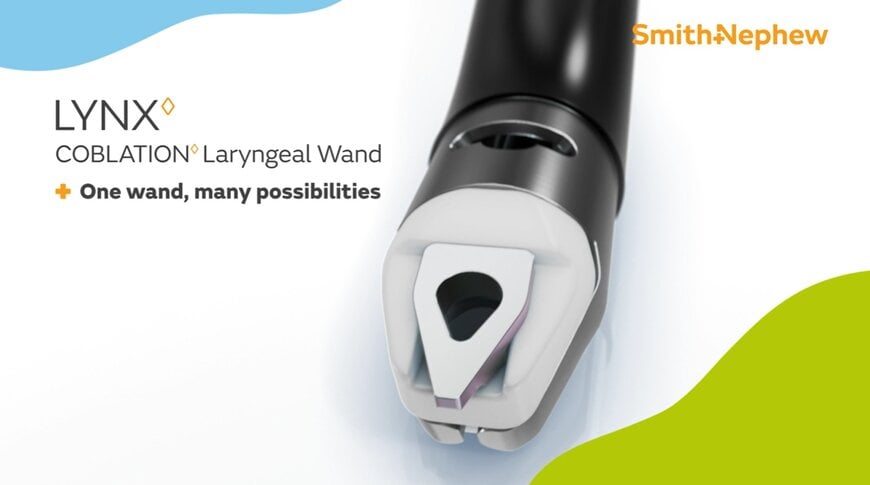
The commercial introduction of the LYNX COBLATION Laryngeal Wand establishes a single-device approach for laryngologists performing soft tissue ablation, resection, coagulation, and hemostasis. By integrating low-temperature tissue clearance with structural design modifications, the system addresses procedural access and safety constraints in delicate airway environments.
Mechanics of Low-Temperature Controlled Ablation
Unlike conventional thermal therapies that rely on extreme heat to burn or vaporize tissue, the system utilizes patented radiofrequency technology to excite electrolytes in a conductive medium, such as saline. This process creates a precisely focused plasma field.
The energized particles in the plasma possess sufficient energy to break molecular bonds within the tissue at relatively low operating temperatures, typically between 40°C and 70°C. This lower thermal profile minimizes collateral damage to surrounding healthy structures and significantly reduces the risk of airway fires, a critical safety consideration during interventions in oxygen-enriched surgical fields.
Structural Adaptations for Airway Accessibility
Surgical interventions within the larynx and trachea require instruments capable of navigating highly constrained anatomical pathways. To address this, the device features a malleable shaft that surgeons can shape manually to match the specific anatomical contours of individual patients.
With an extended working length, the instrument reaches from the supraglottic region down to the trachea. The distal tip is engineered to support both fine, precise dissection and rapid mass debulking. Furthermore, the tip configuration allows surgeons to perform radial incisions through a full 360-degree range of motion without requiring repositioning of the primary instrument shaft.
To maintain procedural flow, the wand incorporates an integrated self-clearing mechanism designed to prevent and clear tissue clogs during active suction and ablation. This reduces the need to remove the instrument from the surgical field for manual cleaning, directly shortening overall procedure times.
Additional Context
This section details technical specifications and competitive benchmarking not included in the original product announcement.
In the field of airway surgery and laryngeal tissue removal, surgical interventions have historically relied on carbon dioxide (CO2) lasers, microdebriders, or standard electrosurgical monopolar/bipolar units.
While CO2 lasers offer high precision, they operate at temperatures exceeding 100°C, presenting a well-documented risk of airway ignition in the presence of supplemental oxygen, alongside risks of thermal spread to delicate vocal fold structures. Microdebriders offer rapid mechanical tissue debulking but lack integrated, instantaneous hemostasis, often requiring the surgeon to switch instruments to control bleeding.
The radiofrequency plasma ablation method benchmarked in this category operates at significantly lower temperatures than both laser and standard electrosurgery, which typically runs between 150°C and 400°C. By combining molecular-level tissue disintegration with immediate coagulation in a single, malleable instrument, the system provides a distinct thermodynamic and mechanical alternative to conventional modalities in laryngological care.
Edited by Evgeny Churilov, Induportals Media - Adapted by AI.
www.smith-nephew.com

