
www.medical-devices.tech
15
'26
Written on Modified on
Pulsed Field Ablation (PFA) & the Transition to Non-Thermal Electrophysiology
An in-depth analysis of the clinical drivers, competitive dynamics, and capital expenditures propelling the shift toward tissue-selective ablation technologies.

Stock Image
Driven by the dual imperatives of eliminating severe procedural complications and maximizing clinical throughput, the medical device industry is rapidly moving beyond traditional energy modalities. The field of electrophysiology is undergoing a structural transition. For decades, thermal ablation has functioned as the standard of care for treating Atrial Fibrillation and other cardiac arrhythmias. However, Pulsed Field Ablation (PFA), a non-thermal alternative, is steadily acquiring market share, redefining procedural safety standards, and influencing capital expenditure planning within the medical device sector.
Supported by favorable safety profiles and increased procedural efficiency, the global PFA market is projected to reach a valuation between 2.0 billion and 3.2 billion dollars by 2026. Industry analysts forecast a Compound Annual Growth Rate of 20 to 33 percent as the technology matures, indicating a potential market valuation approaching 19.3 billion dollars by 2035. Atrial Fibrillation treatments account for the vast majority of projected revenue, primarily driven by recurring consumable catheter sales.
The Technology Paradigm Shift: Thermal vs. Non-Thermal
Traditional modalities, specifically Radiofrequency heating and Cryoablation, are thermally non-selective. While effective at achieving cellular necrosis in targeted arrhythmic tissue, thermal conduction presents a persistent risk of collateral damage to critical adjacent structures, most notably the esophagus and the phrenic nerve.
PFA mitigates these thermal risks through a mechanism known as Irreversible Electroporation. The system delivers high-voltage, microsecond electrical fields that create microscopic pores in cell membranes, inducing cell death. The primary technical advantage is tissue selectivity. Myocardial cells possess a uniquely low threshold for this specific electrical parameter. Consequently, electrophysiologists can achieve targeted myocardial ablation while preserving surrounding esophageal, vascular, and neural tissues.
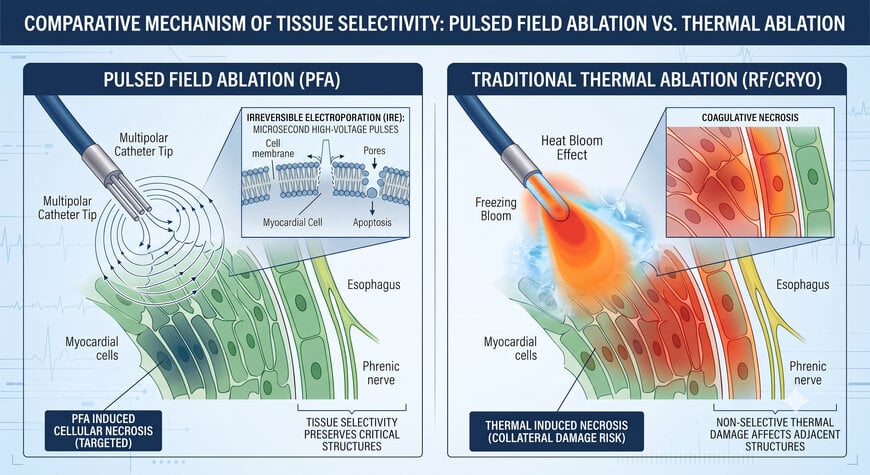
AI generated diagram
Key Market Drivers & Adoption Hurdles
These technical specifications drive two primary market factors: procedural safety and workflow optimization. Clinically, pivotal trials report an absence of esophageal fistulas and persistent phrenic nerve palsy, effectively eliminating the most severe complications associated with thermal ablation. Operationally, the rapid energy delivery reduces overall procedure times. Institutional data suggests standard electrophysiology laboratories can increase annual ablation volumes by 130 to 150 cases without expanding operational hours, presenting a strong return on investment for hospital systems.
However, market penetration faces structural barriers, primarily regarding capital expenditure. Upgrading an electrophysiology suite with a PFA generator and necessary integration hardware requires an estimated 320,000 to 420,000 dollars, compared to the 180,000 to 240,000 dollars required for legacy thermal systems. Additionally, device manufacturers are developing closed ecosystems that closely integrate the ablation catheter, generator, and 3D mapping software. This creates vendor lock-in, requiring hospital administrators to evaluate high switching costs and staff retraining requirements before committing to a specific platform.
Competitive Landscape: The Big Three
Driven by the dual imperatives of eliminating severe procedural complications and maximizing clinical throughput, the medical device industry is rapidly moving beyond traditional energy modalities. The field of electrophysiology is undergoing a structural transition. For decades, thermal ablation has functioned as the standard of care for treating Atrial Fibrillation and other cardiac arrhythmias. However, Pulsed Field Ablation (PFA), a non-thermal alternative, is steadily acquiring market share, redefining procedural safety standards, and influencing capital expenditure planning within the medical device sector.
Supported by favorable safety profiles and increased procedural efficiency, the global PFA market is projected to reach a valuation between 2.0 billion and 3.2 billion dollars by 2026. Industry analysts forecast a Compound Annual Growth Rate of 20 to 33 percent as the technology matures, indicating a potential market valuation approaching 19.3 billion dollars by 2035. Atrial Fibrillation treatments account for the vast majority of projected revenue, primarily driven by recurring consumable catheter sales.
The Technology Paradigm Shift: Thermal vs. Non-Thermal
Traditional modalities, specifically Radiofrequency heating and Cryoablation, are thermally non-selective. While effective at achieving cellular necrosis in targeted arrhythmic tissue, thermal conduction presents a persistent risk of collateral damage to critical adjacent structures, most notably the esophagus and the phrenic nerve.
PFA mitigates these thermal risks through a mechanism known as Irreversible Electroporation. The system delivers high-voltage, microsecond electrical fields that create microscopic pores in cell membranes, inducing cell death. The primary technical advantage is tissue selectivity. Myocardial cells possess a uniquely low threshold for this specific electrical parameter. Consequently, electrophysiologists can achieve targeted myocardial ablation while preserving surrounding esophageal, vascular, and neural tissues.
AI generated diagram
Key Market Drivers & Adoption Hurdles
These technical specifications drive two primary market factors: procedural safety and workflow optimization. Clinically, pivotal trials report an absence of esophageal fistulas and persistent phrenic nerve palsy, effectively eliminating the most severe complications associated with thermal ablation. Operationally, the rapid energy delivery reduces overall procedure times. Institutional data suggests standard electrophysiology laboratories can increase annual ablation volumes by 130 to 150 cases without expanding operational hours, presenting a strong return on investment for hospital systems.
However, market penetration faces structural barriers, primarily regarding capital expenditure. Upgrading an electrophysiology suite with a PFA generator and necessary integration hardware requires an estimated 320,000 to 420,000 dollars, compared to the 180,000 to 240,000 dollars required for legacy thermal systems. Additionally, device manufacturers are developing closed ecosystems that closely integrate the ablation catheter, generator, and 3D mapping software. This creates vendor lock-in, requiring hospital administrators to evaluate high switching costs and staff retraining requirements before committing to a specific platform.
Competitive Landscape: The Big Three
- Boston Scientific
Boston Scientific operates as the early market leader with its FARAPULSE system. Leveraging an estimated market share exceeding 30 percent and the advantage of early global regulatory approvals, the company has established a significant commercial footprint.
- Medtronic
Medtronic is competing with its PulseSelect system and the Sphere-9 catheter. The company's strategy focuses on providing dual-energy capabilities and utilizing its established legacy presence in global hospital networks to drive adoption.
- Johnson and Johnson MedTech
Johnson and Johnson MedTech is advancing its VARIPULSE platform. Its primary strategic differentiator is seamless integration with the CARTO 3D mapping system, the most widely installed mapping technology globally. Recent 12-month clinical data demonstrating an 84.2 percent success rate with zero related complications positions the company to convert its existing CARTO user base to the new ablation platform.
Future Horizons: Where Does PFA Go Next?
Looking forward, the technology's application is expected to expand beyond standard paroxysmal Atrial Fibrillation. Electrophysiologists are beginning to target complex, persistent arrhythmias, which will increase the addressable patient population.
Concurrently, medical device engineers are investigating the application of Irreversible Electroporation outside of cardiology, specifically in precision oncology. Clinical trials are assessing its viability for solid tumor ablation in the liver, prostate, and pancreas. In these complex environments, the capacity to induce tumor cell necrosis while preserving surrounding blood vessels and bile ducts could create a highly lucrative secondary vertical for the PFA market. Ultimately, as PFA matures from a targeted cardiac treatment to a platform technology across multiple medical disciplines, it represents a fundamental redefinition of procedural safety and efficacy in tissue ablation.
Edited by Natania Lyngdoh, Induportals Editor, with AI assistance.
Looking forward, the technology's application is expected to expand beyond standard paroxysmal Atrial Fibrillation. Electrophysiologists are beginning to target complex, persistent arrhythmias, which will increase the addressable patient population.
Concurrently, medical device engineers are investigating the application of Irreversible Electroporation outside of cardiology, specifically in precision oncology. Clinical trials are assessing its viability for solid tumor ablation in the liver, prostate, and pancreas. In these complex environments, the capacity to induce tumor cell necrosis while preserving surrounding blood vessels and bile ducts could create a highly lucrative secondary vertical for the PFA market. Ultimately, as PFA matures from a targeted cardiac treatment to a platform technology across multiple medical disciplines, it represents a fundamental redefinition of procedural safety and efficacy in tissue ablation.
Edited by Natania Lyngdoh, Induportals Editor, with AI assistance.

