
www.medical-devices.tech
09
'26
Written on Modified on
Smith+Nephew Completes First Clinical Cases with CORI XT Platform
CORI XT Handheld Robotic Platform is designed to be the single handheld robotics platform for all orthopedic needs - partial to revision knee, hip, and anatomic and reverse shoulders.
www.smith-nephew.com
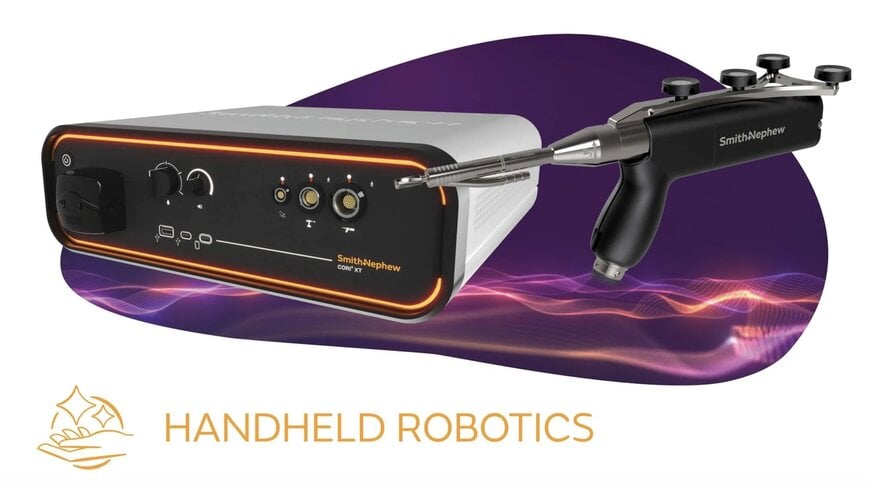
Smith+Nephew has announced the completion of the first clinical cases utilizing the next-generation CORI XT Handheld Robotics Platform. This development marks the initial clinical introduction of the company's latest handheld robotics technology.
Surgical Platform Scope and Workflow Integration
The CORI XT Handheld Robotic Platform is engineered to function as a unified hardware solution for multiple orthopedic requirements, spanning partial-to-revision knee, hip, and anatomic and reverse shoulder arthroplasty. The physical footprint of the system is configured to adapt to the specific space constraints of both traditional hospital operating rooms and ambulatory surgical centers (ASCs).
These initial clinical cases represent the first deployment of the CORI XT platform across both knee and shoulder procedures. The system utilizes an engineering design approach termed "Skill Amplified," which is structured to support and enhance surgeon expertise while preserving manual surgeon control, clinical judgment, and established intraoperative workflows.
Global Arthroplasty Cases and Facility Deployment
The first shoulder arthroplasty cases utilizing the CORI XT platform were completed at Duke Health by a surgical team. The procedure utilized the CORI SHOULDER Handheld Robotic Arthroplasty application in combination with the AETOS Shoulder System. This software and hardware combination provides a complete robotic procedure that supports handheld robotic execution of both the humerus and glenoid bone resections across anatomic and reverse shoulder replacement techniques.
Following the initial hospital cases, subsequent CORI XT shoulder arthroplasty procedures were completed in an ASC setting at the North Valley Surgery Center in Scottsdale, Arizona. This expanded the deployment of the platform across diverse care environments and highlighted the adaptability of the handheld robotics architecture to the workflow of an ASC.
Concurrently, the first knee replacement procedures utilizing the CORI XT platform were completed at NYU Langone Health by a joint replacement specialist. These procedures established the first clinical application of the next-generation platform within knee arthroplasty, serving as a baseline milestone for the broader commercial rollout of the equipment as its software applications expand.
Operational Footprint and Pre-Operative Software
The CORI XT platform is designed to supply the geometric accuracy of robotic assistance while maintaining the operational efficiency and familiarity of conventional open surgical workflows. The handheld mechanical form factor allows surgeons to access robotic cutting guidance and execution support without disrupting procedural flow or introducing external operational complexity to the operating room environment.
The system focuses on increasing execution accuracy while maintaining surgeon control, direct tactile feedback, and real-time intraoperative decision-making. By integrating into existing surgical methodologies, the platform performs consistent bone resections without necessitating modifications to standard operating room configurations or procedural steps.
The compact physical footprint and mobility of the CORI XT hardware support its utilization across both hospital and ASC settings. For patient-specific preparation, the system integrates directly with CORIOGRAPH Pre-Operative Planning and Modeling Services, combining digital pre-operative planning with automated intraoperative execution.
Additional Context
This section details technical specifications not included in the original news release.
Handheld robotic orthopedic platforms rely on active or semi-active boundary-constrained control mechanisms to achieve precise bone resections. Unlike large-format robotic arms that autonomously manipulate a cutting tool, a handheld robotic drill or burr is physically guided by the surgeon's hand while the system dynamically modulates the exposure or velocity of the cutting tip.
The tracking architecture utilizes optical infrared cameras or electromagnetic spatial sensors to continuously monitor the real-time position of rigid arrays affixed to the patient's bone and the surgical instrument. If the surgeon moves the high-speed burr outside the pre-planned digital resection boundary (referred to as a virtual haptic boundary), the system automatically retracts the cutting tool or disables the motor drive within milliseconds. This mechanical constraint prevents the accidental removal of healthy bone and minimizes damage to adjacent collateral ligaments, neurovascular structures, and soft tissue envelopes.
In shoulder arthroplasty, precise positioning of the glenoid component is critical to prevent premature mechanical loosening and implant failure due to eccentric loading, commonly known as the rocking horse effect. Handheld robotic systems assist in mapping the specific version and inclination angles of the glenoid vault.
During pre-operative planning, computed tomography (CT) datasets or magnetic resonance imaging (MRI) scans are converted into three-dimensional polynomial surface meshes. Intraoperatively, the surgeon performs surface registration by touching distinct anatomical landmarks with a tracked probe, aligning the physical bone structure with the virtual model. The robotic software then calculates the optimal alignment for retroversion and superior-inferior inclination, ensuring the reaming axis matches the patient's specific scapular morphology to maximize the cortical bone support area for the subsequent implant baseplate.
Edited by Romila DSilva, Induportals Editor, with AI assistance.
www.smith-nephew.com

