
www.medical-devices.tech
03
'26
Written on Modified on
Smith+Nephew Launches Next Generation LEAF Patient Monitoring System
The LEAF Patient Monitoring System is an innovative pressure injury prevention platform delivering proven clinical impact.
www.smith-nephew.com
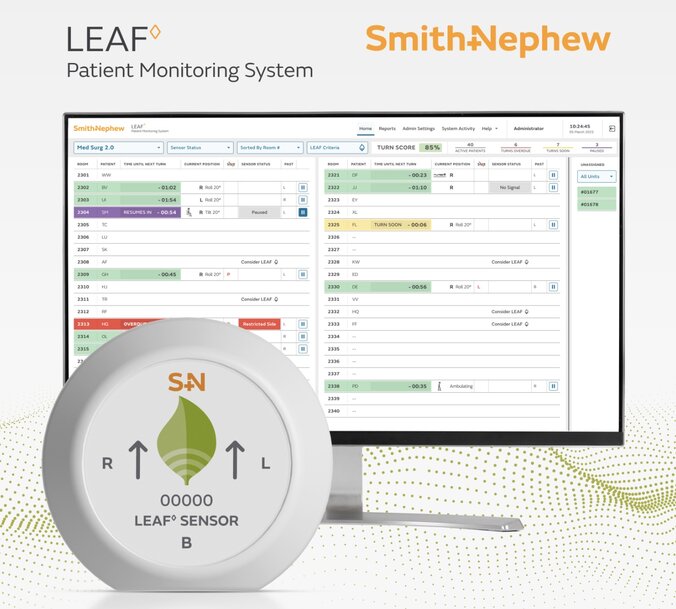
Smith+Nephew has announced the US launch of its next generation LEAF Patient Monitoring System, a data-driven pressure injury prevention platform designed to help healthcare providers manage hospital-acquired pressure injuries (HAPIs) by strengthening clinical protocols and patient outcomes. The system utilizes a wearable sensor to monitor patient mobility and provide real-time turn status updates, aiming to improve workflow efficiency, turn quality, and protocol adherence.
Structural Challenges in Pressure Injury Prevention
Approximately 60,000 annual deaths in the United States are attributed to HAPIs, creating an annual financial burden of $26.8 billion on the nationwide healthcare economy. For individual medical facilities, these injuries can result in millions of dollars in additional expenditures due to extended lengths of hospital stay and patient readmissions. Factors such as staff shortages, workload pressures, and limited data access contribute to protocol inconsistencies, while clinicians face administrative demands to improve patient safety and control costs without compromising outcomes.
Cloud Integration and Reconfigured Interface
The next-generation platform is a cloud-hosted solution featuring a redesigned user interface developed in consultation with multidisciplinary nursing teams. The system is designed to verify that at-risk patients receive repositioning care at appropriate times.
The platform integrates with hospital electronic medical records (EMRs), enabling nurses to monitor turning protocols via real-time data and reporting mechanisms that identify at-risk patients. Because it is hosted on Smith+Nephew’s secure cloud architecture, clinicians can access the platform via any hospital-approved device, shifting focus away from localized system maintenance.
The updated user interface includes document automation functionalities that allow nurses to access critical information and manage patient data. Interdisciplinary medical teams receive instant access to localized patient-level insights alongside a hospital-wide operational view to assess institutional performance over time.
Clinical Validation and Deployment
The LEAF system monitors over 150,000 patients annually. According to company data, the platform reduces the odds of HAPIs by up to 73% and has delivered up to $1.8 million in estimated savings in a single critical care facility.
Rohit Kashyap, President of Advanced Wound Management at Smith+Nephew, stated that scalability, interoperability, and ease of use serve as the primary factors driving adoption and establishing a standard of care in patient turning and repositioning. The next generation of the LEAF Patient Monitoring System is currently commercially available in the United States market.
Additional Context
This section details technical specifications not included in the original news release.
The mechanical etiology of hospital-acquired pressure injuries (HAPIs) involves prolonged external localized pressure exceeding capillary perfusion pressure, which is approximately 32 mmHg. When superficial tissues are compressed between a bony prominence—such as the sacrum, calcaneus, or ischial tuberosity—an external support surface, local microvascular occlusion occurs. This restriction of blood flow causes tissue hypoxia, metabolic waste accumulation, and cellular necrosis, which can progress from superficial erythema to deep structural tissue damage involving muscle and bone.
Automated patient monitoring systems like the LEAF platform utilize miniature wireless sensor pods affixed to a patient's sternum via medical-grade adhesives. These sensors integrate tri-axial MEMS (Micro-Electro-Mechanical Systems) accelerometers that continuously measure gravitational acceleration vectors (g) across three dimensions (X, Y, Z). The internal microprocessor runs proprietary algorithms to calculate the exact angle of lateral tilt, body orientation, and the precise duration of immobility.
The collected telemetry data is transmitted wirelessly via low-power mesh network protocols (such as Zigbee or Bluetooth Low Energy) to wall-mounted receivers linked to the hospital's central server. By calculating the mathematical definite integral of movement dynamics over time, the system monitors turn quality—distinguishing between minor patient self-shifts and true therapeutic repositioning angles (typically greater than 30°). This data populates visual countdown timers at nursing stations to prevent ischemic tissue damage through optimized, scheduled decompression intervals.
Edited by Romila DSilva, Induportals Editor, with AI assistance.
www.smith-nephew.com

