
www.medical-devices.tech
29
'26
Written on Modified on
EU-Certified Multi-Material Denture Printing Workflow
3D Systems enables regulated digital dentistry production with EU MDR-certified multi-material denture solution, supporting scalable, patient-specific manufacturing across European dental laboratories.
www.3dsystems.com
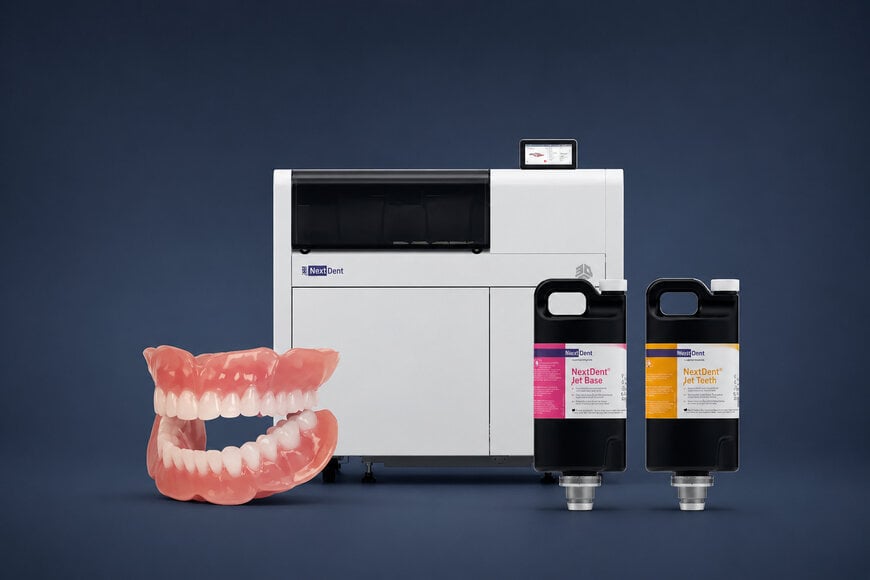
The 3D Systems has obtained Class IIa certification under the EU Medical Device Regulation 2017/745 for its multi-material denture manufacturing workflow, enabling full commercial deployment across European dental markets starting May 4, 2026.
Regulatory Approval Expands Digital Dentistry Adoption
The certification applies to the integrated workflow combining the NextDent 300 MultiJet 3D printer with Jet Base and Jet Teeth materials. Under MDR 2017/745, Class IIa devices are classified as moderate-risk medical products, requiring validated clinical data, traceability, and stringent quality management systems.
This regulatory milestone allows dental laboratories in the European Union to deploy a fully compliant additive manufacturing workflow for denture production. It also expands the addressable market to more than 60 million edentulous patients across the United States and Europe, positioning the system within a multi-billion-euro dental prosthetics segment.
The earlier-than-expected approval accelerates European market entry by approximately two months compared to the initially planned summer rollout, enabling earlier adoption within the regional digital supply chain for dental prosthetics.
Monolithic Multi-Material Printing in a Single Process
The system introduces a monolithic, multi-material jetting approach in denture fabrication. Unlike conventional workflows that require separate fabrication and bonding of denture base and teeth, this process produces a unified structure in a single print cycle.
Using MultiJet printing technology, the platform deposits different photopolymer materials with high spatial resolution, enabling:
- Simultaneous fabrication of gingiva and tooth structures
- Fully cured output without secondary post-curing steps
- Reduced manual assembly and bonding variability
This approach improves dimensional accuracy and repeatability compared to traditional analog denture manufacturing methods, which typically involve multiple manual stages such as wax setup, flasking, and polymerization.
Production Efficiency and Clinical Performance
The elimination of post-curing steps and reduction in manual intervention directly impact production throughput in dental laboratories. The system is designed to support batch manufacturing with consistent material properties and predictable outcomes.
Early clinical feedback from the U.S. deployment indicates improved patient outcomes in three measurable areas:
Production Efficiency and Clinical Performance
The elimination of post-curing steps and reduction in manual intervention directly impact production throughput in dental laboratories. The system is designed to support batch manufacturing with consistent material properties and predictable outcomes.
Early clinical feedback from the U.S. deployment indicates improved patient outcomes in three measurable areas:
- Fit accuracy due to digital design and controlled layer deposition
- Mechanical durability from optimized material integration
- Aesthetic quality through multi-material gradation
These characteristics align with broader trends in the digital dentistry ecosystem, where automation and material science integration are used to standardize prosthetic quality while reducing production time.
Integrated Workflow and Application Scope
The solution provides a complete workflow including hardware, certified materials, software, and validated process parameters. This level of integration reduces interoperability challenges often associated with fragmented dental manufacturing systems.
Primary application areas include:
Integrated Workflow and Application Scope
The solution provides a complete workflow including hardware, certified materials, software, and validated process parameters. This level of integration reduces interoperability challenges often associated with fragmented dental manufacturing systems.
Primary application areas include:
- Full denture fabrication for edentulous patients
- High-throughput dental laboratory production
- Custom prosthetics requiring patient-specific geometries
By enabling repeatable, regulatory-compliant production, the system supports the transition from artisanal denture fabrication to industrialized additive manufacturing within dentistry.
Market Context and Positioning
The European denture market represents a significant share of global dental prosthetics demand, driven by demographic trends and increasing adoption of digital workflows. Within this context, the availability of an MDR-certified, end-to-end additive manufacturing solution addresses both regulatory and operational barriers to adoption.
The system’s reliance on proprietary materials also introduces a recurring revenue model tied to material consumption, a common characteristic of industrial additive manufacturing platforms.
Conclusion
With MDR Class IIa certification, the NextDent denture workflow becomes one of the first fully compliant multi-material additive manufacturing systems for dental prosthetics in Europe. Its ability to produce monolithic dentures in a single, validated process marks a shift toward scalable, standardized production within the digital dentistry landscape.
Edited by an industrial journalist Sucithra Mani with AI assistance.
www.3dsystems.com
Market Context and Positioning
The European denture market represents a significant share of global dental prosthetics demand, driven by demographic trends and increasing adoption of digital workflows. Within this context, the availability of an MDR-certified, end-to-end additive manufacturing solution addresses both regulatory and operational barriers to adoption.
The system’s reliance on proprietary materials also introduces a recurring revenue model tied to material consumption, a common characteristic of industrial additive manufacturing platforms.
Conclusion
With MDR Class IIa certification, the NextDent denture workflow becomes one of the first fully compliant multi-material additive manufacturing systems for dental prosthetics in Europe. Its ability to produce monolithic dentures in a single, validated process marks a shift toward scalable, standardized production within the digital dentistry landscape.
Edited by an industrial journalist Sucithra Mani with AI assistance.
www.3dsystems.com

