
Automated Organ-on-Chip Manufacturing for Drug Testing
Festo and TU Darmstadt develop automated bioprinting system for microfluidic organ models to improve preclinical drug evaluation efficiency.
www.festo.com
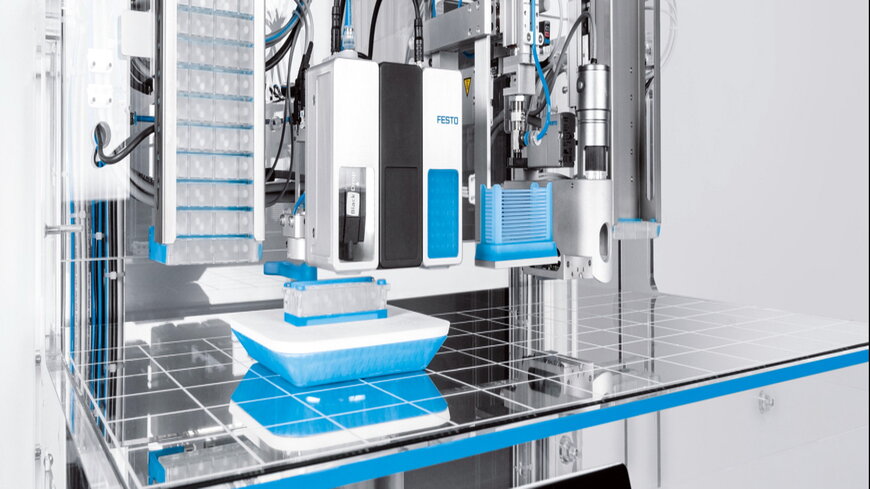
The cooperation between Festo and TU Darmstadt focuses on automating organ-on-a-chip production using integrated bioprinting and microfluidic technologies for life science and pharmaceutical applications.
Context of the Cooperation
Drug development involves multi-stage validation processes, where preclinical models often fail to replicate human physiological responses. This leads to high attrition rates during clinical trials, increasing development time and cost. Organ-on-a-chip systems aim to address this gap by replicating organ-level functions on microfluidic platforms.
The collaboration combines Festo’s expertise in industrial automation with TU Darmstadt’s research in microfluidics and tissue engineering. The objective is to create a scalable and reproducible process for manufacturing microphysiological systems suitable for early-stage drug testing.
Technical Solution and Responsibilities
The system integrates a bioprinting process with automated handling and fluid control technologies. A bioprinter deposits human cell material onto microfluidic chips, where controlled environmental conditions enable tissue formation.
Festo provides key enabling technologies:
- SupraMotion system: A superconducting magnetic levitation platform enabling contactless transport of microfluidic chips. This reduces particle contamination and supports cleanroom-compatible operation.
- Diffusion Bonded Manifolds: Multi-layer polymer components with microchannels designed for precise fluid distribution. These manifolds enable accurate dosing, mixing, and routing of cell culture media and reagents within the chip.
The solution is demonstrated as an automated production workflow, covering:
- Bioprinting of cell structures onto chips
- Transport between process steps using levitation-based carriers
- Integration of fluidic supply through bonded manifolds
Primary applications include pharmaceutical R&D and biotechnology:
- Preclinical drug screening using human-relevant tissue models
- Toxicology testing with controlled microenvironments
- Disease modeling for personalized medicine research
Results and Expected Impact
Organ-on-a-chip systems can reduce reliance on animal testing and improve prediction accuracy in preclinical studies. Automation enhances reproducibility by standardizing cell deposition, fluid handling, and environmental control. The contactless transport mechanism reduces contamination risk, while microfluidic precision supports consistent experimental conditions. Together, these factors contribute to improved process stability and reduced variability in biological assays. The cooperation demonstrates how combining automation engineering with life science research can enable scalable production of complex biological test systems.
Edited by an industrial journalist Sucithra Mani with AI assistance.
www.festo.com

