
www.medical-devices.tech
30
'26
Written on Modified on
AI-Guided Mitral Valve Repair Imaging Workflow
Royal Philips introduces AI-assisted imaging software to support minimally invasive mitral valve repair procedures within a connected cardiology ecosystem.
www.philips.com
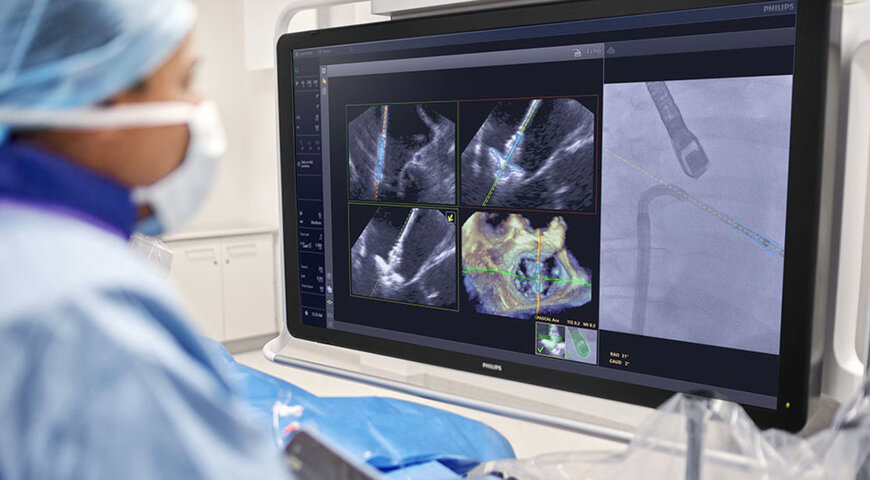
Royal Philips has obtained U.S. FDA 510(k) clearance for an AI-powered software solution designed to assist physicians during minimally invasive mitral valve repair procedures. The technology integrates real-time imaging and device tracking to improve procedural guidance in interventional cardiology.
Addressing complexity in structural heart interventions
Mitral regurgitation, affecting more than 35 million patients globally, requires precise intervention due to the anatomical variability of the mitral valve. Minimally invasive techniques such as transcatheter edge-to-edge repair (M-TEER) rely on catheter-based delivery systems and continuous imaging guidance.
During these procedures, clinicians must simultaneously interpret fluoroscopy (X-ray) and echocardiography (ultrasound) across multiple displays while coordinating device positioning in a moving cardiac structure. This creates a high cognitive and technical workload, particularly in complex cases.
Real-time AI integration in the cath lab
The newly cleared software builds on echo-fluoro fusion imaging by combining live echocardiography data with X-ray imaging into a unified visualization environment. It incorporates an AI algorithm that automatically tracks and displays the position and orientation of the mitral valve repair device in real time.
By aligning imaging data with the device trajectory, the system provides a consolidated procedural view, including overlays such as trajectory lines and orientation indicators. This reduces the need for manual image adjustments and supports more consistent navigation during device deployment.
The software is designed to function as an assistive layer rather than an autonomous system. Physicians retain full procedural control, while the AI enhances situational awareness and spatial interpretation inside the beating heart.
Integration into a digital supply chain of cardiology data
The solution operates within an integrated platform that combines imaging systems, real-time procedural data, and software tools into a unified workflow. This reflects a broader shift toward a digital supply chain in cardiology, where diagnostic imaging, procedural guidance, and post-operative monitoring are interconnected.
In practical terms, the software enables synchronized visualization across the interventional team, improving communication between cardiologists and echocardiographers. Clinical feedback indicates that automatic image alignment and device tracking can reduce unnecessary repositioning and improve implantation precision.
Clinical validation and collaboration
The development involved collaboration with clinical centers in Europe and the United States, including specialized structural heart programs. Early clinical experience published in peer-reviewed literature describes the use of AI-supported imaging during M-TEER procedures, highlighting improvements in workflow efficiency and visualization consistency.
The system is currently designed for compatibility with specific mitral valve repair devices, reflecting a co-development approach between imaging technology providers and device manufacturers.
Application scope and availability
The technology targets interventional cardiology, particularly structural heart procedures performed in catheterization laboratories. These include mitral valve repair cases where high-resolution imaging and precise device navigation are critical.
Following FDA clearance, availability depends on regulatory approval and market release in different regions. The system is expected to be demonstrated at major cardiology conferences, including the American College of Cardiology meeting in New Orleans in 2026.
Positioning within AI-assisted intervention systems
AI-assisted imaging platforms are increasingly used in structural heart interventions, particularly for image fusion and procedural guidance. Compared with conventional dual-screen workflows, integrated fusion imaging with automated device tracking provides measurable advantages in workflow consolidation and visualization accuracy.
By embedding AI directly into intraoperative imaging, the solution contributes to ongoing efforts to standardize complex procedures and reduce variability in clinical outcomes.
Edited by an industrial journalist Sucithra Mani with AI assistance.
www.philips.com

