
www.medical-devices.tech
29
'26
Written on Modified on
TE Connectivity introduces 3D printing process for catheter manufacturing
New 3D printing process helps medical device manufacturers accelerate catheter development, improve consistency and enable new design possibilities.
www.te.com
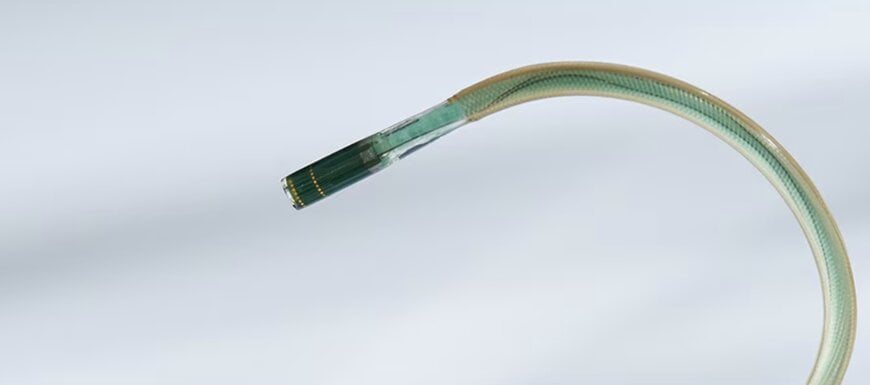
TE Connectivity has introduced an automated 3D printing process to manufacture catheter shafts for medical device manufacturers. The technology replaces a higher-cost, predominantly manual assembly process traditionally utilized across the medical manufacturing industry.
Automated Polymer Layering and Manufacturing Locations
Catheter devices often require multiple polymer jacket sections with varying flexibility characteristics along the length of the shaft. The additive manufacturing technology applies these polymer sections directly onto the catheter shafts during production.
Developed by the Advanced Technology Group within TE’s Medical business unit at the PROPELUS Prototype Center in Galway, Ireland, the process is designed to improve manufacturing speed and consistency. The resulting catheter shafts maintain equivalent mechanical properties, material compositions, and aesthetic properties compared to those produced using traditional assembly methods.
Design Iteration and Architectural Possibilities
The process enables engineering teams to iterate catheter designs more rapidly, accelerating new device development for medical equipment manufacturers. Furthermore, the technology enables the introduction of novel catheter constructions and device architectures that are impractical to fabricate using conventional manufacturing techniques.
Pat Duane, Senior Vice President and General Manager of the Medical business at TE Connectivity, stated that additive manufacturing technologies have the potential to expand design possibilities, accelerate development timelines, and support future catheter manufacturing frameworks.
Additional Context
This section details technical specifications not included in the original news release.
Catheter shafts utilized in minimally invasive cardiovascular, neurovascular, and structural heart procedures require a gradient of mechanical flexibility along their longitudinal axis. Proximally, the shaft requires higher column strength and torsional stiffness (pushability and torquability) to advance through the vascular system. Distally, the shaft must be significantly more flexible (trackable) to navigate tortuous vessel geometries without causing traumatic vessel perforation.
Conventionally, this variable flexibility is achieved by manually placing discrete tubes of varying durometer polymers—such as polyether block amide (PEBAX), nylon, or polyurethane—over an inner lubricious liner (often PTFE) and a braided or coiled metallic reinforcement layer. The assembly is then encased in a Fluorinated Ethylene Propylene (FEP) heat-shrink tube and passed through a vertical reflow oven, melting the polymer jackets so they fuse into a continuous multi-durometer shaft.
Automating this process via direct-write 3D printing or micro-extrusion deposition applies variable-durometer thermoplastic elastomers directly onto the rotating sub-assembly. By dynamically altering the volumetric dispense rate, polymer formulation, or layer thickness along the shaft length, additive manufacturing creates seamless stiffness transitions without manual jacket placement, reducing tactile stiff spots and structural delamination risks at polymer interface boundaries.
Edited by Romila DSilva, Induportals Editor, with AI assistance.
www.te.com

