
www.medical-devices.tech
20
'26
Written on Modified on
CT-Guided PCI Workflow Integrates Coronary Imaging and Intervention
Siemens Healthineers introduces an integrated workflow that connects coronary CT analysis with catheter lab guidance for percutaneous coronary intervention planning and execution.
www.siemens-healthineers.com
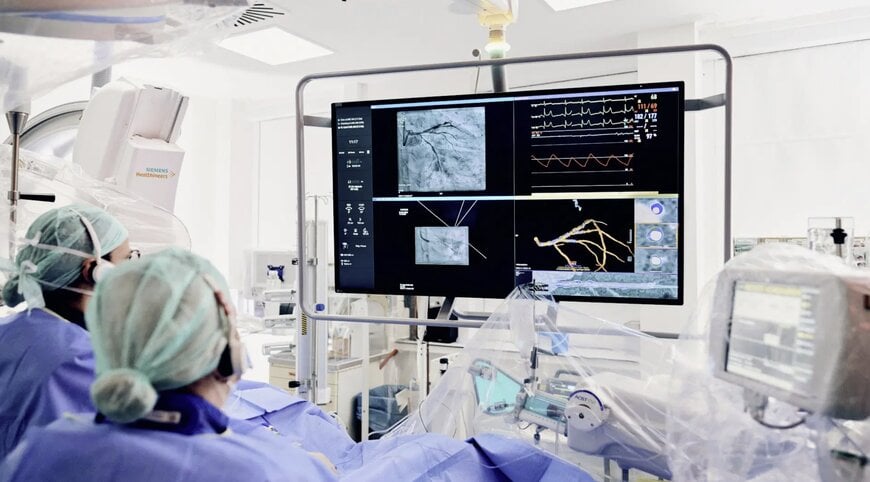
Coronary intervention workflows are increasingly incorporating pre-procedural imaging to improve lesion assessment and procedural planning before patients enter the catheterization laboratory. Siemens Healthineers’ latest integration combines CT-derived coronary analysis with live angiography guidance, targeting interventional cardiology workflows for coronary artery disease treatment.
End-to-End Imaging Workflow for Coronary Intervention
The system, introduced at EuroPCR 2026 in Paris, combines Syngo.CT Coronary Cockpit on the Syngo.via platform with Syngo PCI Connect on the new Artis angiography systems, creating a connected workflow that spans diagnosis, plaque analysis, intervention planning, and intraprocedural guidance.
The architecture is designed for CT-guided percutaneous coronary intervention (PCI), a minimally invasive procedure used to restore coronary blood flow in patients with coronary artery disease.
Traditional PCI workflows typically rely on two-dimensional invasive angiography for visualization of coronary arteries. While clinically established, 2D angiography can limit characterization of plaque morphology, vessel geometry, and lesion complexity, potentially affecting stent sizing accuracy and landing zone selection.
By integrating pre-procedural coronary CT angiography (CCTA), the workflow shifts anatomical assessment earlier in the treatment pathway, allowing clinicians to review vessel structure, plaque burden, lumen dimensions, and procedural angles before intervention begins.
CT-to-Cath Lab Data Integration
The technical differentiator is direct integration of pre-processed CT data into the angiography environment.
The system displays anatomical reconstructions, plaque information, lumen measurements, side-by-side image views, and planned stent markers directly within the cath lab interface. This reduces workflow fragmentation between imaging review workstations and intervention suites.
A core synchronization feature links the angiography C-arm with CT imaging orientation. When the C-arm moves, the CT visualization automatically updates to maintain alignment. The reverse interaction also applies: when the operator adjusts the CT view to identify the preferred vessel angle, the C-arm can automatically reposition accordingly.
This bidirectional synchronization introduces a procedural guidance model that uses CT-derived planning data as a live navigation reference rather than a separate diagnostic input.
Role of Advanced Cardiac CT in PCI Planning
CT-guided PCI has gained relevance as cardiac CT imaging has improved in spatial resolution and plaque characterization.
The workflow is particularly relevant when paired with advanced cardiac CT systems, including photon-counting CT, which can provide higher-resolution coronary imaging for anatomical analysis and lesion assessment. Siemens Healthineers has positioned photon-counting CT as part of broader cardiovascular imaging workflows.
Earlier decision-making can improve cath lab resource planning, including scheduling, staffing, and equipment allocation. Instead of identifying anatomical complexity during invasive angiography, operators enter the procedure with predefined anatomical insight and intervention strategy.
This approach aligns with broader healthcare digital workflow integration, where imaging data is increasingly treated as part of a connected clinical decision infrastructure rather than isolated diagnostic output.
Clinical Workflow Implications for Interventional Cardiology
Potential benefits include reduced procedural uncertainty, fewer imaging interpretation transitions, and more structured PCI execution.
Integrated lesion visualization may be particularly relevant in complex coronary anatomy, calcified lesions, multivessel disease, and interventions where stent placement accuracy directly affects outcomes.
Because PCI procedures expose both patients and staff to ionizing radiation, workflow efficiency may also influence cumulative exposure, although no procedural reduction metrics were disclosed in the announcement.
The solution builds on Siemens Healthineers’ prior image-guided interventional cardiology software portfolio, including CT fusion and coronary guidance tools, but extends workflow continuity across the complete CT-guided PCI pathway.
Additional Context
This section details technical specifications and competitive benchmarking not included in the original news release.
Comparable image-guided cardiology workflows exist from vendors including Philips and GE HealthCare, particularly in image fusion, coronary visualization, and interventional guidance. The differentiating claim here is full workflow continuity between coronary CT analysis and live PCI execution within a single integrated vendor ecosystem. Competing platforms often support procedural image fusion or standalone coronary planning, but fewer combine pre-procedural CT analysis, live angiography guidance, and bidirectional synchronization between imaging views and hardware positioning within a unified coronary intervention workflow.
Edited by Aishwarya Mambet, Induportals Editor, with AI assistance.
www.siemens-healthineers.com

