
www.medical-devices.tech
26
'26
Written on Modified on
Collaborative Development of Robotic Spine Surgery Platform
Novanta Inc. and Cyber Surgery advance precision sensing for ALAYA surgical robotics.
novanta.com
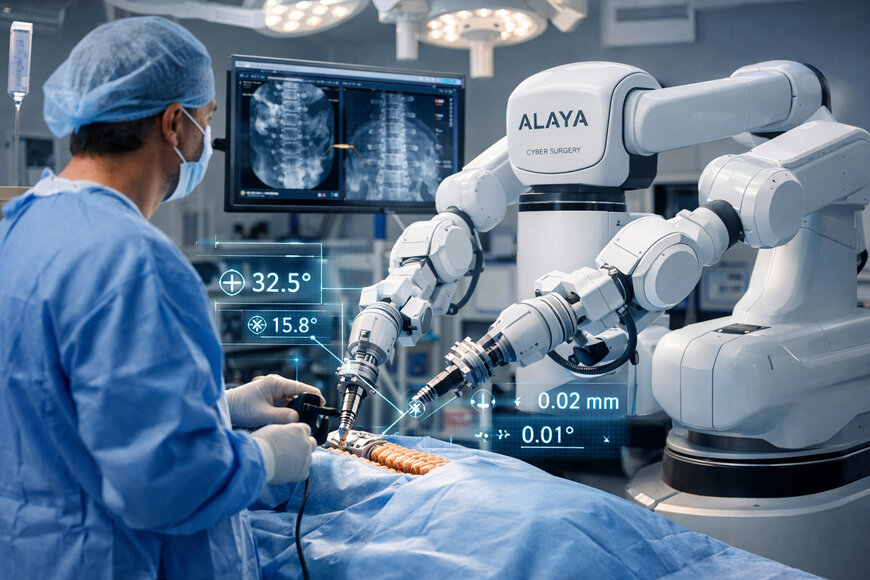
Novanta Inc. and Cyber Surgery have jointly developed key sensor and motion technologies for the ALAYA surgical robotics platform to address precision and reliability in spine surgery applications across clinical environments.
Novanta Inc., a global supplier of precision motion, sensing, and control technologies for medical and industrial systems, collaborated with Cyber Surgery, the developer of the ALAYA robotic surgical assistant, to integrate advanced position sensing and redundant feedback systems into a next-generation surgical robotics platform for spine procedures. The cooperation targets medical robotics and industrial automation of surgical systems where accuracy, safety, and consistent intra-operative performance are critical.
Context of the Cooperation
Cyber Surgery designed and brought to certification the ALAYA surgical robotic assistant, which is intended to support minimally invasive spinal procedures through patented kinematic navigation technology that overcomes limitations of line-of-sight optical systems. ALAYA has achieved CE certification under the EU Medical Device Regulation MDR 2017/745, confirming compliance with stringent safety and performance requirements for clinical use in Europe.
Novanta Inc. contributes core precision sensing technologies that provide real-time joint position feedback with built-in redundancy. These components are essential in robotic motion control to ensure exact positioning, low latency feedback, and system reliability under clinical operating conditions. Novanta’s portfolio includes force/torque sensors, precision motion encoders, and servo drive subsystems that meet demanding medical robotics performance parameters.
Technical Solution and Responsibilities
The cooperation centered on co-creation of sensor subsystems tailored to the kinematic requirements of ALAYA’s robotic arms. Novanta’s engineering teams engaged with Cyber Surgery across R&D, quality, and product integration phases to refine sensor tolerances, signal conditioning, and redundancy mechanisms that support continuous position monitoring. Through iterative design cycles, responsibilities were divided as follows: Cyber Surgery defined clinical specifications for spinal navigation and control logic; Novanta delivered custom sensing modules with precision better than typical clinical thresholds; and both partners validated integration through joint testing protocols.
These sensing systems interface with the robot’s motion control architecture to provide closed-loop feedback, supporting navigation algorithms and reducing positional uncertainty. Redundant sensing also enhances functional safety, enabling detection of anomalous measurements and fallback responses according to industry safety standards for medical robotics.
Deployment and Implementation
ALAYA is deployed in clinical environments following MDR CE marking, integrating with existing operating room infrastructure, imaging systems, and surgical workflows. The joint development included verification of compatibility with hospital network requirements for medical devices and traceability systems such as Unique Device Identification (UDI) under MDR.
Cyber Surgery is responsible for system-level integration, clinical workflow adaptation, and compliance documentation, while Novanta provides ongoing engineering support for sensor calibration, production quality, and supply continuity.
Applications and Use Cases
The platform is designed for spinal surgical interventions where precise guidance and secure instrument positioning are required. Specific use cases include spinal fusion and bone resection, where displacement errors on the order of millimetres can affect clinical outcomes. Novanta’s sensing technologies contribute measurable positional stability that supports surgeon decision support and robotic accuracy.
Expected Impact
The collaboration is expected to improve intra-operative confidence by reducing cognitive load on surgeons through reliable robotic positioning. By embedding redundant high-fidelity sensing, the solution enhances procedural stability and safety, aligning with clinical performance standards for robotic assistance. The cooperative development also establishes a modular foundation for future generations of surgical robotics systems that can leverage shared platforms and scalable architectures.
www.novanta.com

